About Catharus bicknelli (Ridgway, 1882)
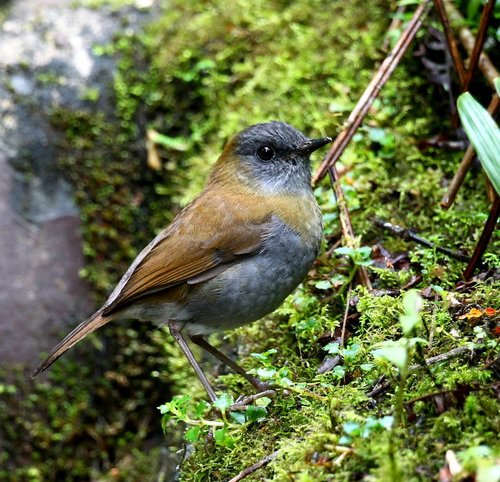
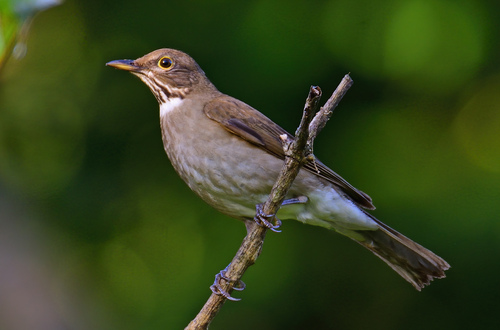
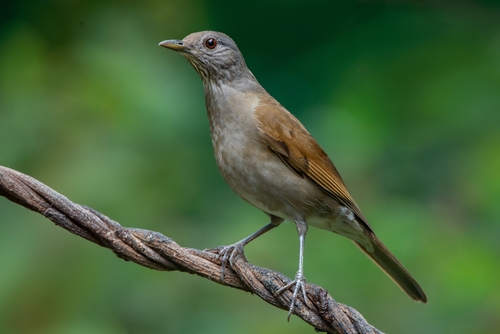
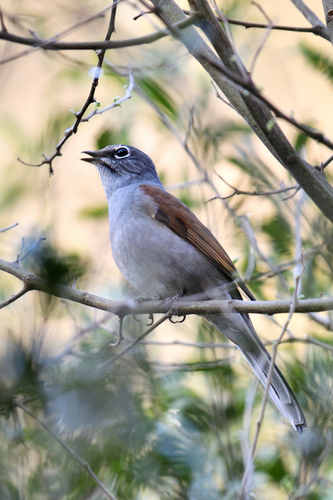
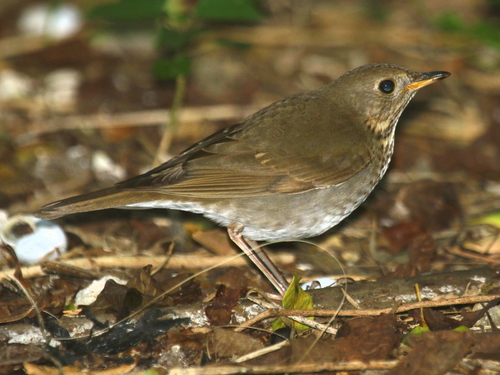
Bicknell's thrush, Catharus bicknelli, is slightly smaller than other northern migratory Catharus thrushes, with an average length of approximately 17 cm (6.7 in) and a typical weight range of 26 to 30 g. Both sexes look identical when observed in the field and are roughly the same size, though males average slightly longer wing lengths. Adult upperparts, including the head, nape, and back, are olive-brown to brownish, which contrasts with a chestnut-tinged tail. This contrast is less visible in worn plumage. Underparts are off-white with gray coloring on the flanks; the off-white breast has a buffy wash and dusky spots that grow more diffuse toward the sides and lower breast. This species has pink legs, a faint gray eye ring, and gray cheeks. Two-thirds of the lower mandible is yellow, while the tip of the lower mandible and the entire upper mandible are blackish. Bicknell's thrush averages slightly smaller than the very similar gray-cheeked thrush, and the two are almost indistinguishable in outward appearance. Its song is a jumbled series of flute-like tones that ends on a higher note. Bicknell's thrush has a scattered breeding range that extends from southeastern Quebec to Nova Scotia in Canada, and includes the sky islands of northern New England, as well as the Adirondacks and Catskills in New York. It is the rarest and most secretive breeding thrush in North America, and is the only bird species with a breeding range entirely restricted to the northeastern portion of the continent. It is a habitat specialist within its breeding range. It favors high altitude coniferous forests affected by strong winds and heavy ice conditions, and usually breeds at higher elevations, normally nesting above 915 m (3,002 ft). It also lives in successional forests recently impacted by forest industry, so its breeding habitat is best characterized as highly disturbed forest with small, stunted trees. During migration, Bicknell's thrush acts more as a habitat generalist. Bicknell's thrush, gray-cheeked thrush, and veery form a closely related group of migratory species. This bird migrates to the Greater Antilles, with an estimated 90% of individuals wintering on Hispaniola, mostly in the Dominican Republic with some also in Haiti. During the winter, it lives in broadleaf forests at various elevations, but generally prefers higher elevations. Wintering individuals have been recorded in the Cordillera Central, Sierra de Baoruco, and Cordillera Septentrional mountain ranges in the Dominican Republic, the Massif de la Hotte in Haiti, the Cordillera Central in Puerto Rico, the Blue Mountains in Jamaica, and the Sierra Maestra in eastern Cuba. Ticks, blowflies, and lice are common parasites that Bicknell's thrush must deal with. According to breeding ecology studies, the American red squirrel is the main predator of Bicknell's thrush eggs and nestlings. Confirmed predators of nesting adult Bicknell's thrushes are the sharp-shinned hawk, the long-tailed weasel, and the northern saw-whet owl. At least six other predators are suspected or likely to prey on Bicknell's thrush nests on nesting grounds, and at least three other predators may attack nesting adults, not including potential predators encountered during migration or on wintering grounds.