About Catharus aurantiirostris (Hartlaub, 1850)
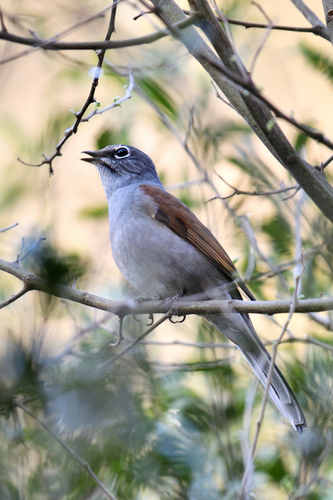
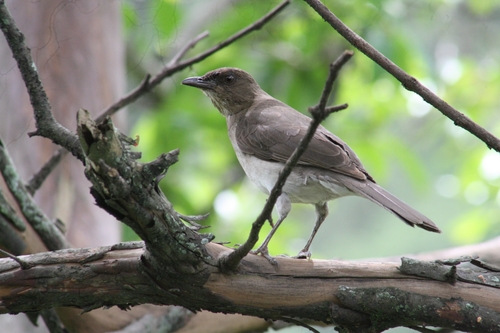
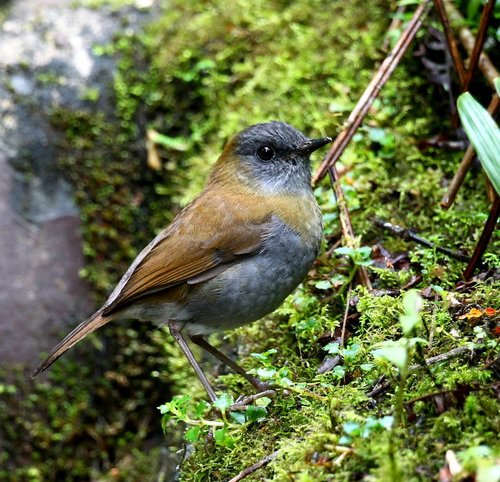
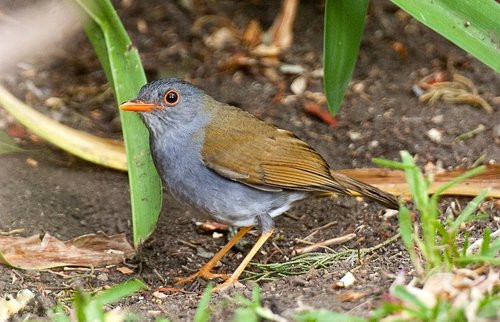
The orange-billed nightingale-thrush, with the scientific name Catharus aurantiirostris (Hartlaub, 1850), measures 15.5 to 17 cm (6.1 to 6.7 in) long and weighs 21 to 32 g (0.74 to 1.1 oz). Males and females have identical plumage. Adults of the nominate subspecies C. a. aurantiirostris are olive-brown, with a rufous tint on their crown, nape, back, rump, wings, and tail; the rufous coloration is most prominent on the rump, wings, and tail. Their face is grayish brown with a thin orange eye-ring. Their throat is whitish, and this color darkens to pale gray across the rest of their underparts. They have a long, strong orange bill and brownish orange legs and feet. Juveniles are mostly brown, with extensive buff flecking and mottling. The other subspecies differ from the nominate subspecies and from one another as follows: C. a. clarus has warm olive-brown upperparts; C. a. melpomene has more rufous color on its wings and tail; C. a. costaricensis has richer rufous color on its wings and tail than melpomene; C. a. griseiceps has a gray head and grayer underparts; C. a. phaeopleurus is similar to griseiceps, with stronger olive-brown upperparts and an orange-red bill; C. a. birchalli is more rufous, with darker gray flanks; C. a. barbaritoi has no rufous on its upperparts and has darker grayish underparts; C. a. sierrae is similar to the nominate subspecies; C. a. inornatus has stronger olive-brown upperparts, whiter throat and underparts than griseiceps, no rufous coloration, and an orange-red bill; C. a. insignis is duller than the nominate subspecies, with vague streaks on the throat. The orange-billed nightingale-thrush has a disjunct distribution, with each subspecies occupying a separate range: C. a. clarus is found in Mexico from southwestern Chihuahua south to western Puebla and southwestern Tamaulipas; C. a. melpomene ranges from Puebla and Veracruz in southern Mexico south through Guatemala and El Salvador and across Honduras; C. a. costaricensis is found in northwestern and central Costa Rica; C. a. griseiceps ranges from southwestern Costa Rica into western Panama as far as Chiriquí and Veraguas provinces; C. a. phaeopleurus is found in central Colombia; C. a. aurantiirostris occurs in the Venezuelan Coastal Range and inland in Guárico; C. a. birchalli is found in Trinidad and the northeastern Venezuelan states of Anzoátegui, Sucre, and northern Monagas; C. a. barbaritoi occurs in Serranía del Perijá on the Colombia-Venezuela border; C. a. sierrae is found in the isolated Sierra Nevada de Santa Marta in northern Colombia; C. a. inornatus occurs on the western slope of Colombia's Eastern Andes in Santander Department; C. a. insignis is found on the eastern slopes of Colombia's Western and Central Andes. The South American Classification Committee has documented records of this species in Brazil. There are two records from the United States: one bird was photographed in southern Texas in 1996, and another was photographed in South Dakota in 2010, and this second record was accepted by the South Dakota Ornithologists' Union. The orange-billed nightingale-thrush lives in a variety of forest types in the upper tropical and subtropical zones. Its habitats include the edges of both lowland and montane evergreen forest, and the interior of pine-oak forest, deciduous forest, and secondary forest. In Central and South America it also occurs in semi-deciduous forest, gardens, coffee plantations, and (at least in Venezuela) urban areas. Sources disagree on the species' overall elevational range: one source states it ranges overall from 400 to 2,300 m (1,300 to 7,500 ft), while another gives an overall range of 600 to 2,500 m (2,000 to 8,200 ft). Regionally, it ranges from 600 to 2,850 m (2,000 to 9,400 ft) in Guatemala and Honduras, 500 to 2,200 m (1,600 to 7,200 ft) in Costa Rica, 900 to 1,650 m (3,000 to 5,400 ft) in Panama, 600 to 2,300 m (2,000 to 7,500 ft) in Colombia, and 800 to 2,900 m (2,600 to 9,500 ft) in Venezuela.