About Cathartes burrovianus Cassin, 1845
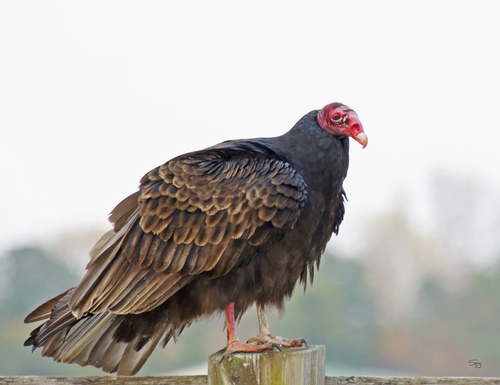
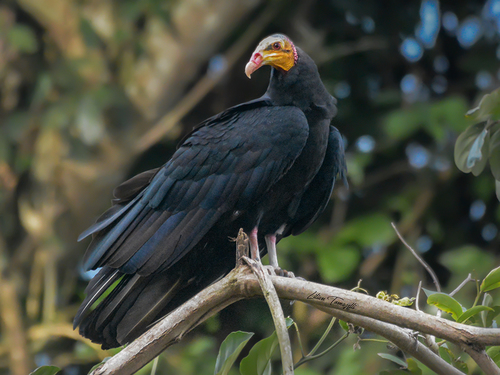
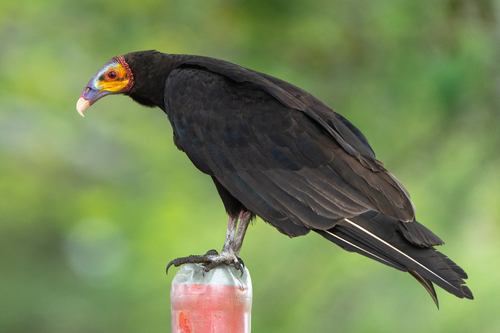
The lesser yellow-headed vulture, Cathartes burrovianus Cassin, 1845, is the lightest and smallest of all living New World vultures, even though it can sometimes match the overall length and exceed the wing length of black vultures. Adults measure 53–66 cm (21–26 in) in total length, with a wingspan of 150–165 cm (59–65 in), a tail length of 19–24 cm (7.5–9.4 in), and a body weight between 0.95 and 1.55 kg (2.1 to 3.4 lb). Its plumage is black with a green sheen. The throat and sides of the head are featherless; the entire head and neck are bare, with yellow skin, a reddish forehead and nape, and a gray-blue crown. This vulture has red irises, white legs, a flesh-colored beak, a single incomplete row of eyelashes on the upper eyelid and two rows on the lower eyelid. The tail is rounded and relatively short for a vulture, and the tip of a closed wing extends past the end of the tail. Immature individuals have browner plumage, a dusky-colored head, and a white nape. The beak is thick, rounded, and hooked at the tip. Its front toes are long, with small webbing at their bases, and are not adapted for grasping. The nostril opening is longitudinal, and the nostrils have no septum. Like all New World vultures, the lesser yellow-headed vulture does not have a syrinx, so it can only produce a low hiss and no other vocal sounds. It can be distinguished from the similar greater yellow-headed vulture in multiple ways: it is smaller and less heavily built, with a shorter, thinner tail. Its plumage is browner than the greater yellow-headed vulture's dark, glossy black plumage. It has lighter-colored legs, and its head has a stronger orange tinge than the more intensely yellow head of the greater yellow-headed vulture. Its flight is also less steady than that of the greater yellow-headed vulture. Unlike the greater yellow-headed vulture, which prefers forest habitats, the lesser yellow-headed vulture lives primarily in savannas. It also shares visual similarities with the turkey vulture. This species is distributed across Argentina, Belize, Bolivia, Brazil, Chile, Colombia, Costa Rica, Ecuador, El Salvador, French Guiana, Guatemala, Guyana, Honduras, Mexico, Nicaragua, Panama, Paraguay, Peru, Suriname, Uruguay, and Venezuela. Its natural habitats are subtropical or tropical seasonally wet or flooded lowland grassland, swamps, mangroves, and heavily degraded former forest. It may wander across dry fields and clearings, and it is not generally found in high-altitude regions. The species' crow-like appearance led to the naming of Uruguay's Quebrada de los Cuervos (Crows Ravine), where it lives alongside black vultures and turkey vultures. In terms of ecology and behavior, the lesser yellow-headed vulture flies alone, holding its wings in a dihedral position. It glides at low altitudes over wetlands to locate food, and perches on fence posts and other low perches. It almost always flies alone and is rarely seen in groups. It uses static soaring flight, relying on thermals to maintain altitude without flapping its wings. It rarely soars at high elevations, preferring to stay at low altitudes. It is thought to be partially migratory, moving in response to changes in water levels in its habitat. Like other New World vultures, the lesser yellow-headed vulture practices urohidrosis: it urinates or defecates on its legs to cool them through evaporation.