About Catephia linteola Guenée, 1852
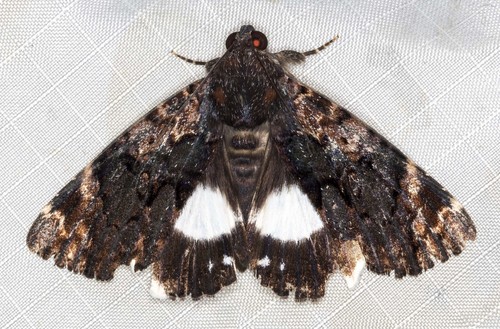
This species, Catephia linteola Guenée, 1852, has a wingspan of approximately 56 to 66 mm. The antennae of males are almost simple. Male forelegs have thick scale tufts growing from the coxa, and very long hairs growing from the femur and tibia. The head and thorax are black and dark red-brown with a purplish gloss, while the abdomen is blackish. The forewings are red-brown with more or less black markings. A short sub-basal line is visible, and there are also waved antemedial, medial, and postmedial lines. The postmedial line is strongly angled outwards beyond the end of the cell. There is a small black spot or ring-spot in the cell, an indistinct reniform spot, and a ring-spot below the reniform spot. Traces of an irregularly waved submarginal line are present, and the apex is speckled with white. The hindwings are black with a pure white medial band that does not reach the inner margin. The apex is white, and more or less developed white submarginal spots are present toward the anal angle. The larva has a greyish-brownish-green head marked with fine brown lines. Its body is similar in color to the head, but also has chocolate-toned coloring. The tubercles are light reddish brown, and the ventral side is whitish, with black patches between the prolegs and true legs. Pupation occurs in a cocoon that is spun on a tree trunk. The larvae feed on species of Terminalia elliptica, Corymbia tesselaris, and Lagerstroemia speciosa.