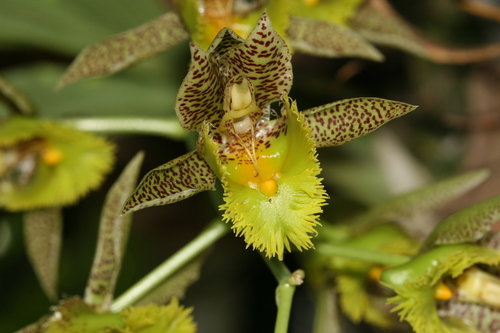
About Catasetum fimbriatum (C.Morren) Lindl.
Catasetum fimbriatum, commonly called the fringed catasetum, is a flowering plant that belongs to the orchid family and grows in warm tropical environments. It uses an unusual strategy to transfer pollen to other conspecific flowers with the help of insects, most commonly bees. When a pollinator lands on a male Catasetum fimbriatum flower and stimulates it, pollen is deposited onto the pollinator's back. This guarantees that the plant's gametes will be carried to other flowers of the same species that the bee visits. The mechanism by which male C. fimbriatum ejects pollen onto visiting bees is still not fully understood, though kinetic studies of the process have been completed. When a bee lands on the flower, it stimulates the flower's antennae, which triggers a rapid change in membrane potential. This change propagates an action potential that leads to an increase in turgor pressure, which immediately causes pollen to be ejected onto the bee's back. According to Simon et al., the ejection force can sometimes knock the bee off the flower entirely. This forceful ejection is likely an evolved adaptation that prevents cross-pollination. Darwin's bee-trap experiment analyzed the kinetics and activation of this trigger mechanism that deposits pollen onto the backs of bees. Researchers carried out frame-by-frame analysis of the process using a V5.0 digital camera capable of capturing 1,000 images per second. They activated the antennae that trigger the pollen catapult using a small wire. Many other prior experiments have already detected electrical changes in membrane potential in other plant species. This includes work with the carnivorous Venus flytrap done using ion-selective micro-electrodes, and work with the Mimosa plant done using a combination of ion analysis and X-ray fluorescence spectroscopy. Future experiments that use these existing techniques could give a clearer, more detailed understanding of how Catasetum fimbriatum's pollen ejection mechanism works at the molecular level.