About Catananche lutea L.
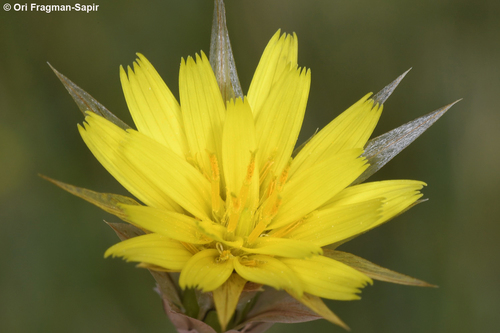
Catananche lutea L. is a low to medium-height annual herbaceous plant, typically growing 8–40 cm (3–16 in) tall. It forms a basal leaf rosette, is diploid, and has 18 chromosomes (2n = 18).
This species produces two types of flower heads: aerial flower heads held on long erect stems, and subterranean flower heads that grow on very short stems between or under the leaves of the basal rosette. Aerial flowers are pollinated by a wide variety of insects, but self-fertilisation also occurs, and is likely the only form of fertilisation for horizontal flower heads.
Subterranean flower heads contain two types of cypsela, while aerial flower heads produce three distinct types of cypsela located in different positions: next to the involucre, encircling the centre, and at the centre of the receptacle. Subterranean cypselas develop between February and April. They are fewer in number, but much larger and heavier than aerial cypselas. A high proportion of the first type of subterranean cypselas germinates quickly, while germination of the second type is spread over time due to inhibition from hormones in the fruit skin. Aerial cypselas form between April and May, and none of the three aerial types show delayed germination, though they differ in how they disperse. Aerial cypselas located next to the involucre have short, scaly pappus, and are subtended by a bract. These cypselas are released along with the entire flower head when it breaks away from the dead mother plant, which results in short-distance dispersal. By contrast, cypselas at the centre of the aerial flower head have much longer pappus, dislodge much earlier, and are carried by wind over longer distances. The third type of aerial cypsela has intermediate-length pappus, and may either remain in the flower head or be carried off by wind.
Subterranean cypselas spread germination out over time. One type is adapted to extend the species' presence into the next growing season at a site already known to be suitable, while the second type contributes to the soil seed bank to support germination in case of unfavorable years. Aerial cypselas, on the other hand, disperse the plant's progeny into new areas. Through its varied fruit types, Catananche lutea exhibits multiple survival strategies: quick and delayed germination, in situ retention, short-distance and long-distance seed dispersal, both self-fertilization and cross-fertilization, and production of some ripe seeds early in the growing season.
Catananche lutea prefers calcareous (chalky), loamy soils in open, disturbed habitats. It grows on vertisols in a climate with wet winters and dry, hot summers. It occurs in association with the species Cerinthe major, Convolvulus tricolor, Fedia cornucopia, Fedia scorpioides, Glossopappus macrotus, Hedysarum coronarium, Hedysarum glomeratum, Lavatera trimestris, Malope trifida, and Salvia viridis.