About Cataglyphis bombycinus (Roger, 1859)
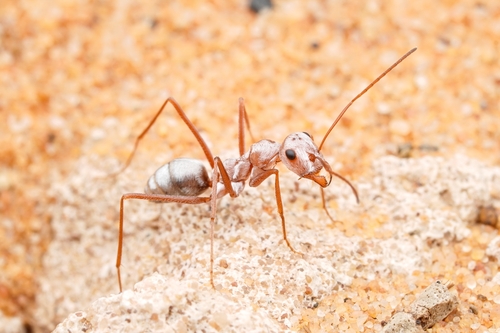
The Saharan silver ant, scientific name Cataglyphis bombycinus, is an ant species that lives in the Sahara Desert. It is the fastest of the world's 12,000 known ant species, reaching a speed of 855 millimetres per second, which is over 1.9 miles per hour or 3.1 kilometres per hour. It can travel 108 times its own body length per second, a body-size relative speed only topped by two other creatures: the Australian tiger beetle Rivacindela hudsoni and the California coastal mite Paratarsotomus macropalpis. This speed is nearly equal to the walking pace of a human being; scaled to human body size, it would correspond to a speed of about 200 m/s (720 km/h) for an 180 cm (6 ft) tall human runner. Largely due to the extremely high temperatures of their Saharan habitat, plus the constant threat of predators, these ants are active outside their nest for only around ten minutes each day. The combined pressures of predation and extreme heat restrict their above-ground activity to a narrow temperature range: between the temperature where predatory lizards stop being active and the ants' own upper temperature threshold for survival. The ants often move through midday temperatures around 47 °C (117 °F) to scavenge the corpses of animals that have died from heat exposure. To survive these high temperatures, the species has several unique adaptations. When moving at full speed, Saharan silver ants only use four of their six legs, achieving this quadrupedal gait by raising their front pair of legs. Along with this unusual gait, a very high stride frequency contributes to making C. bombycinus one of the fastest walking animal species when measured relative to body size. These ants navigate by keeping track of the sun's position, which lets them always take the most direct route back to their nest, minimizing the time they spend exposed to extreme heat. A small number of scout ants monitor predator activity and alert the rest of the colony when ant-eating lizards retreat into their burrows. Once alerted, the entire colony of hundreds of ants leaves the nest to forage for food, and they must complete their foraging trip before temperatures reach 53 °C (127 °F) — a temperature that is lethal to the species. Saharan silver ants produce heat shock proteins (HSPs), but unlike most other animals, they do not produce these proteins in direct response to heat exposure. Instead, they produce the proteins before leaving the nest, preventing initial damage when their body temperature rises quickly. These HSPs allow cellular functions to continue working even when the ants' body temperature is very high. If the ants did not produce these proteins in advance of encountering extreme heat, they would die before the proteins could take effect. As one researcher noted, the production of this protein "does not reflect an acute response to cellular injury or protein denaturation, but appears to be an adaptive response allowing the organism to perform work at elevated temperatures during temperature changes too abrupt to give the animal an opportunity to benefit from de novo HSP synthesis." The researcher further adds that "the few minutes duration of the foraging frenzy is too short for synthesis of these protective proteins after exposure to heat." This adaptation and others have led to the Saharan silver ant being described as "one of the most heat-resistant animals known." The species has a critical thermal maximum of 53.6 °C (128.5 °F). The top and sides of a Saharan silver ant's body are covered in a layer of uniquely shaped hairs with triangular cross-sections that keep the ant cool in two distinct ways. These hairs are highly reflective under both visible and near-infrared light, which covers the region of maximal solar radiation. The hairs are also highly emissive in the midinfrared portion of the electromagnetic spectrum, where they act as an antireflection layer that improves the ants' ability to release excess heat through thermal radiation from their hot bodies to the surrounding air. This passive cooling effect works even under full direct sun. The cooling adaptation of Saharan silver ants has inspired research in the field of passive daytime radiative cooling.