About Casuarius casuarius (Linnaeus, 1758)
Scientific Classification
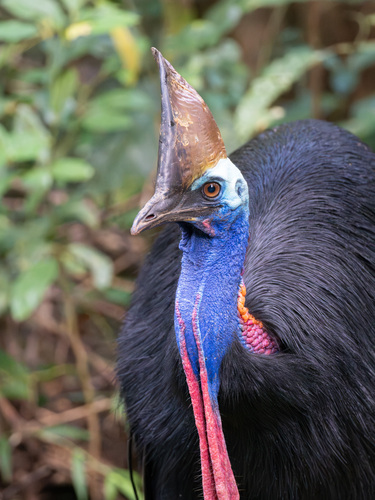
The southern cassowary (scientific name Casuarius casuarius (Linnaeus, 1758)) has stiff, bristly black plumage, a blue face and long neck, red coloring on the cape, and two red wattles that hang around the throat, measuring around 17.8 cm (7.0 in) long.
Head Casque
A horn-like brown casque, 13 to 16.9 cm (5.1 to 6.7 in) high, sits on top of its head.
Bill Length
Its bill can range from 9.8 to 19 cm (3.9 to 7.5 in) long.
Sexual Dimorphism
Its plumage is sexually monomorphic, but females are dominant and larger, with longer casques, larger bills, and brighter-colored bare skin.
Juvenile Plumage
Juveniles have brown plumage with longitudinal stripes.
Foot Structure
The southern cassowary has thick, powerful three-toed feet, with a lethal dagger-like claw up to 12 cm (4.7 in) long on the inner toe.
Size Ranking
It is possibly the largest member of the cassowary family, and is tied as the third heaviest bird on Earth, after the Somali ostrich and common ostrich.
Maximum Size
Its maximum size is estimated at 85 kg (187 lb) and 190 cm (6 ft 3 in) tall.
Typical Length and Height
Normally, this species has a total length of 127 to 170 cm (4 ft 2 in to 5 ft 7 in), and a standing height of 150 to 180 cm (4 ft 11 in to 5 ft 11 in).
Gender Weight Averages
Females average 58.5 kg (129 lb), while males average 29 to 34 kg (64–75 lb).
Adult Weight Range
Most adult southern cassowaries weigh between 17 and 70 kg (37 and 154 lb).
Northern Cassowary Comparison
On average, the northern cassowary is about the same size, and has very slightly less sexual dimorphism than the southern cassowary.
Regional Size Status
Technically, the southern cassowary is the largest living Asian bird following the extinction of the Arabian ostrich, and the largest living Australian bird, though emus may be slightly taller.
Geographical Distribution
The southern cassowary is distributed across Indonesia, Papua New Guinea, and northeastern Australia.
Habitat Types
It mainly lives in tropical rainforests, but may also use nearby savannah forests or mangrove stands.
Elevation Preference
This species prefers elevations below 1,100 m (3,600 ft) in Australia, and below 500 m (1,600 ft) in New Guinea.
Breeding Population Data Source
As of 2018, according to Birdlife International, the breeding populations were as follows:


