About Casuarina glauca Sieber
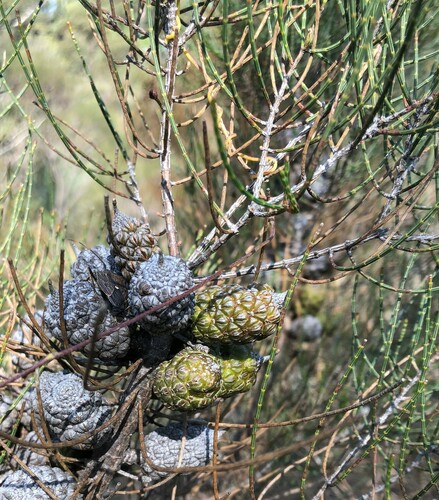
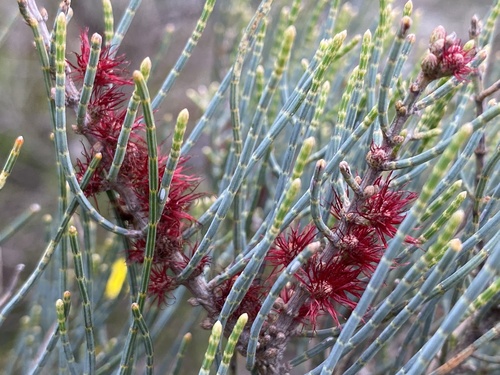
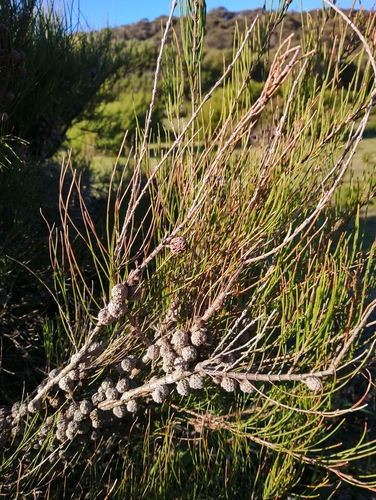
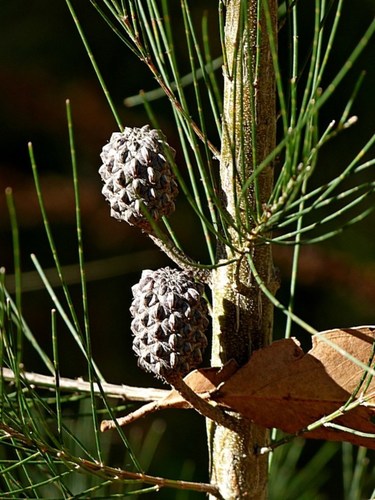
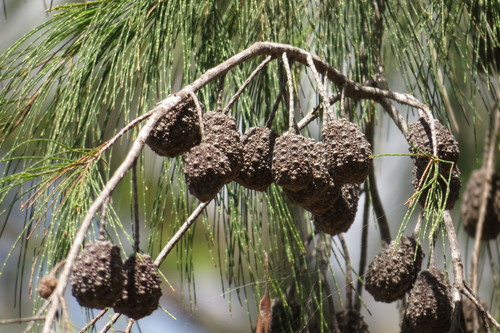
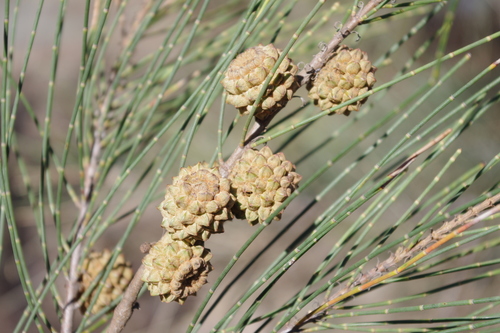
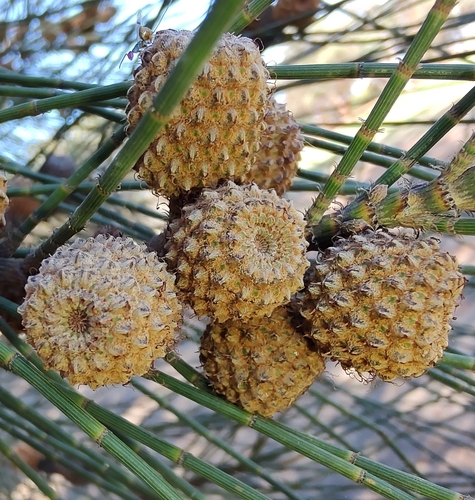
Casuarina glauca Sieber, commonly called swamp she-oak, is a dioecious tree that most often reaches 8–20 m (26–66 ft) in height, and may occasionally grow as tall as 35 m (115 ft). Rarely, it grows as a shrub around 2 m (6 ft 7 in) tall. This species often produces root suckers, and forms dense stands of trees via root suckering. Its bark is greyish brown, fissured and scaly. The drooping branchlets can grow up to 380 mm (15 in) long. The true leaves are reduced to scale-like teeth 0.6–0.9 mm (0.024–0.035 in) long, arranged in whorls that most often contain 12 to 17 teeth around each branchlet. Young scale teeth are long and curved backward. The sections of branchlet between leaf whorls, called "articles", are 8–20 mm (0.31–0.79 in) long and 0.9–1.2 mm (0.035–0.047 in) wide. Male flowers grow in spikes 12–40 mm (0.47–1.57 in) long, arranged in whorls of 7 to 10 per centimetre (per 0.4 inch), with anthers around 0.8 mm (0.031 in) long. Female cones grow on a 3–12 mm (0.12–0.47 in) long peduncle, and are sparsely covered with soft white to rust-coloured hairs when young. Mature cones are 9–18 mm (0.35–0.71 in) long and 7–9 mm (0.28–0.35 in) in diameter, and the paired winged seeds (samaras) are 3.5–5.0 mm (0.14–0.20 in) long. This species is native to Australia's east coast, where it occurs from Yeppoon in central Queensland to Bermagui in southern New South Wales. Some stands growing within the Royal Botanic Gardens in Sydney predate European settlement, and it is a predominant species in the Coastal Swamp Oak Forests of southeastern Australia. Populations along the New South Wales coastline are at risk due to habitat clearing for development. It naturally grows in or near brackish water along river and estuary banks, on alluvial soils derived from sandstone or shale, where the water table is 30 cm or less below the surface. By preventing erosion and trapping sediment among its roots, dense stands of C. glauca can convert shallow open water into solid land. C. glauca is an actinorhizal plant that forms nitrogen-fixing root nodules colonized by the symbiotic bacterium Frankia. Its nodules have a regular arrangement of cell layers that contain flavans, and produce a unique hemoglobin distinct from the leghemoglobin produced by leguminous plants. This species can live up to 200 years. It regenerates after fire by resprouting from roots, and cut stumps produce vigorous suckers that grow into dense new groves. Mature trees drop large volumes of plant litter, mostly made up of old cones and branchlets. This litter eventually decomposes to enrich the soil, unless it is removed by flood events. Understory plant species recorded in C. glauca groves include Juncus kraussii, Baumea juncea and Sporobolus virginicus on sandier soils, and Apium prostratum, Carex appressa, Goodenia ovata, Juncus kraussii, Phragmites australis, and the vine Parsonsia straminea on clay soils. The epiphytic orchid Dendrobium teretifolium (rat's tail orchid) commonly grows on C. glauca trunks. Glossy black cockatoos break open C. glauca cones to eat the seeds, which mature in winter. The seeds are also eaten by red-browed finches and peaceful doves (Geopelia placida). Outside its native range, C. glauca has naturalized in the Florida Everglades, where it is considered an invasive weed. In cultivation, it has been widely planted as a street tree in Canberra, Australia. It was introduced to Haiti to stabilize soil and provide timber for poles, and to Florida to be grown as an ornamental plant and windbreak. Its bark has been used as a growing medium for mounted orchids. This species tolerates waterlogged soils and soils with moderate salinity. A major downside of planting it in urban areas is that its roots can invade underground water and sewer pipes if the pipes are within 15 m (50 ft) of the tree. By lowering the water table, it can also increase acidification of acid sulphate soils. Two prostrate cultivars of C. glauca are commercially available. 'Cousin It' originated from material collected in 1989 at Booderee National Park on the New South Wales south coast, and is named for its resemblance to the character Cousin Itt. 'Kattang Karpet' is propagated by the Australian Botanic Garden from material collected in 1998 at Kattang Nature Reserve on the New South Wales mid-north coast.