About Castilleja septentrionalis Lindl.
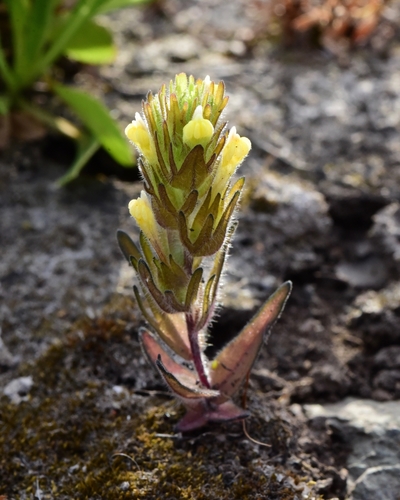
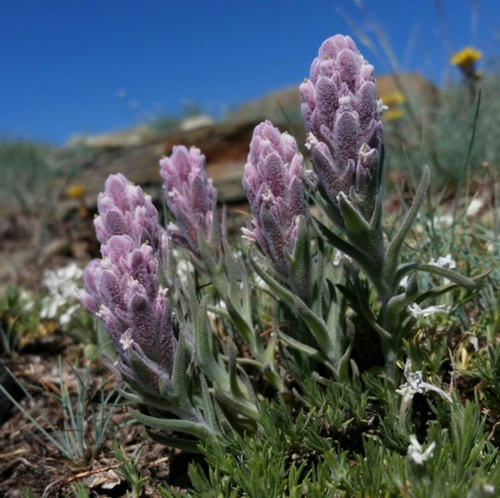
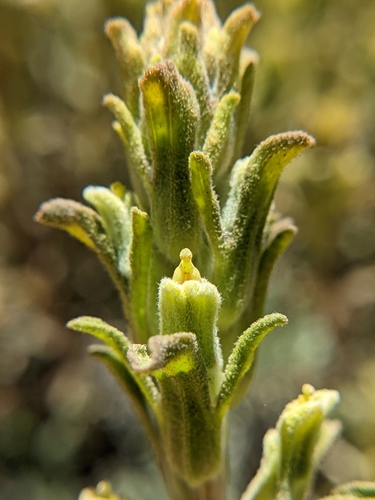
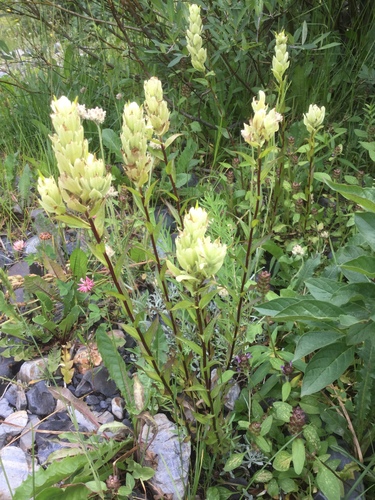
Castilleja septentrionalis Lindl. is a perennial herb that typically grows 25 to 55 centimeters tall, though it may reach as short as 15 centimeters or as tall as 70 centimeters. It usually grows in small, dense colonies. Like many other Castilleja species, it obtains some of its nutrients by parasitizing the roots of other plants. Its underground structure consists of a woody caudex sitting atop either a single taproot or branched roots, which may be either slender or thick. When mature, each plant produces a clump of stems, which vary in number; these stems grow straight upwards, or curve outward from the base before growing upwards. Stems may be branched or unbranched, and are covered in short, stiff glandular hairs, though the stem base is sometimes hairless or nearly hairless (glabrous or glabrate). The leaves of Castilleja septentrionalis range in color from green to purplish, and are shaped from narrow to broad spear-head (linear-lanceolate to lanceolate). They are usually 2 to 7 centimeters long, and occasionally grow about 1 centimeter longer. Leaves are sometimes divided into up to three lobes, and the tip of each leaf or lobe is bluntly pointed, rather than rounded or very sharp. The leaves are also very thin, with easily visible veins. Flowering occurs from May to September, and occasionally starts as early as April. The pale yellow-green inflorescences of this species measure 2.1 to 11 centimeters tall and 1.5 to 4 centimeters wide. The large, colored structures of the inflorescence are bracts, not petals. While bracts are usually sulfurous yellow to green where they attach to the stem, they may be brown-purple near the base. They shade to white, cream, or canary yellow at the tips, and occasionally have a rose blush or a tint of buff or light tan. Bract shape is similar to the species' leaves: they are lanceolate to oblong or obovate, sometimes fully lanceolate, and may have anywhere from zero lobes to three lobes, and occasionally as many as five. The central lobe is bluntly pointed, matching the leaf tips, while the side lobes are more sharply pointed (acute). The actual flowers are much smaller. The flower sepals (calyx) are usually 13 to 23 millimeters long, and reach a maximum length of 28 millimeters. The sepals share the same color as the larger bracts. The two petals are 18 to 30 millimeters long and straight, and are united into a tube 10 to 20 millimeters long. They are green to yellowish in color. Castilleja septentrionalis is a very widespread species. It is found from the southern Rocky Mountains in New Mexico north to the Northwest Territories in Canada, and throughout much of eastern Canada and the northern parts of New England. In the U.S. Rocky Mountain states, it grows in Colorado, Idaho, Montana, New Mexico, Utah, and Wyoming, with a somewhat disjunct population in the Black Hills of South Dakota. In Canada, it is found in the Rocky Mountain provinces of Alberta and British Columbia, in the arctic in the Northwest Territories and Nunavut, and also in Labrador, New Brunswick, Newfoundland, Ontario, and Québec. In New England it grows in Maine, New Hampshire, and Vermont, and is only found rarely in Michigan and Minnesota. In New Hampshire, it is an alpine obligate, typically found in patch communities associated with heavy late-melting snow, which provides both moisture and protection from weather. It is only found in northern regions or at high elevations. In 2015, NatureServe evaluated Castilleja septentrionalis as a species separate from Castilleja sulphurea, and gave it a global conservation status of globally secure (G5). At the subnational level, NatureServe rated it as secure (S5) in Ontario, apparently secure (S4) on the Island of Newfoundland, in Labrador, and in Quebec. In Maine, the population was rated as vulnerable (S3), the Michigan population as imperiled (S2), and critically imperiled (S1) in New Hampshire and Vermont. In 2002, NatureServe evaluated Castilleja sulphurea in the Rocky Mountains as globally secure (G5), and only evaluated the populations of Montana and Wyoming, which they found to be apparently secure (S4).