About Castilleja rhexifolia Rydb.
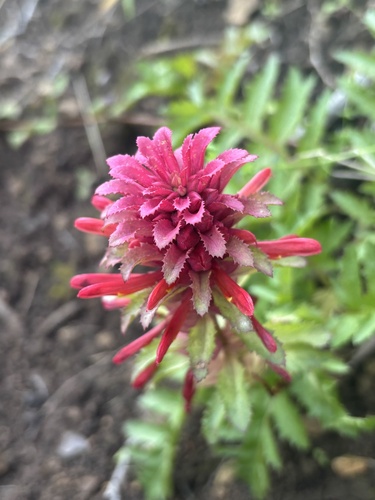
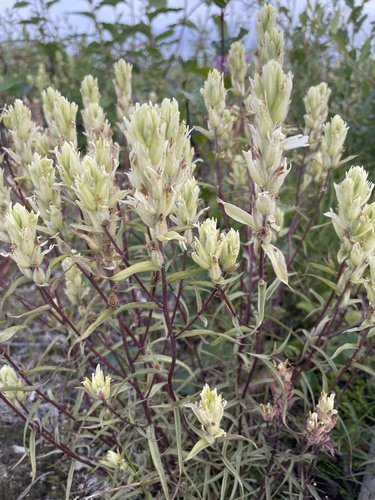
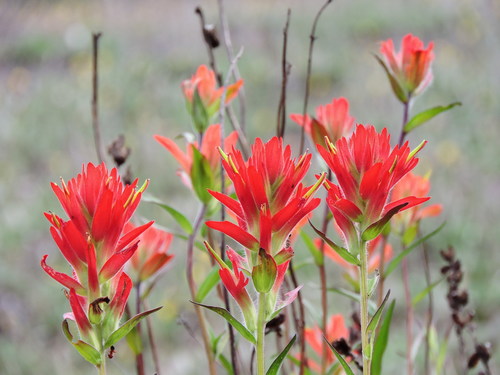
Castilleja rhexifolia Rydb. (common name alpine paintbrush) is a perennial herb that grows 10 to 80 centimeters tall at maturity, most commonly between 25 and 60 centimeters. It grows from a woody-topped taproot with a caudex, from which new herbaceous stems grow each year. A single plant produces a few to many stems, which are either erect growing straight upward from the base or ascending growing outward slightly before curving upward. Most stems are unbranched, though branching occurs occasionally. Near the base, stems are hairless or nearly hairless (glabrous to glabrate), while the upper sections are sparsely covered in long soft hairs, sometimes with gland-tipped (stipitate-glandular) hairs. The leaves of this species can be green or have a purple tint, and vary in shape: linear (grass-like), lanceolate (narrow or broad spear-shaped, wider at the middle and tapered toward both ends), oblong (somewhat rounded rectangular), or ovate (egg-shaped). Most leaves are 3 to 6 centimeters long, rarely reaching 7 centimeters. Leaves are thin rather than fleshy, have three easily visible veins, and are either flat or slightly rolled inward (involute). Leaf tips may be unlobed or have three lobes, all usually ending in narrow points; when side lobes are present, they are narrower than the central lobe. The showy inflorescences of Castilleja rhexifolia are relatively large, 2.5 to 15 centimeters long and 1.5 to 4.5 centimeters wide. They are surrounded by large, brightly colored modified leaves called bracts, which may be pink-purple, red-purple, purple, or crimson. Rarely, bracts can be pale red, yellowish, or white. Most bracts are uniformly colored from base to tip, but occasionally they are greenish, dull brown-purple, or deep purple near the base, with one of the other common colors on the rest of the bract. Bracts can be sparsely to densely covered in fine hairs with a slightly sticky (viscid-pilose) texture. Bracts have a similar shape range to the plant's photosynthetic leaves: broadly lanceolate, ovate, or obovate (teardrop-shaped, widest toward the tip). Bract tips may be unlobed or have up to seven lobes, but most commonly have 3 to 5 lobes that develop past the midpoint of the bract. The central lobe has a broad, blunt tip, while the side lobes are more sharply pointed, only rarely rounded. The sepals are joined into a tube (called a calyx) that almost fully hides the flower, and matches the bright color of the bracts, with a green, purple, or whitish base. The sepal tube is 15 to 25 millimeters long, with clefts at the tip that extend 40 to 50% of the tube length on the top and bottom (abaxial and adaxial sides), and 15 to 30% of the length on the two side edges. The lobes formed by these clefts are oblong to triangular, usually with blunt or rounded ends. The petals are joined into a tube for most of their length, and are almost completely hidden inside the sepal tube. The corolla is straight, 15 to 36 millimeters long, usually less than 30 millimeters. The tube portion of the corolla ranges from 11 to 24 millimeters long, most often 12 to 24 millimeters. The top of the corolla splits into a beak that sticks out past the sepals, measuring about 7 to 12 millimeters long, roughly one third of the total corolla length. The lower lip of the corolla is deep green and small, measuring 1 to 3 millimeters, with three small inward-curving lobes called teeth that are 0.5 to 2 millimeters long. Overall, the petals are green, yellow, or faintly red. Within its native range, this species flowers from May to September, with occasional flowering as early as March. Its fruit is a capsule approximately 12 millimeters long. Castilleja rhexifolia is most often mistaken for Castilleja miniata, another similarly-colored paintbrush with overlapping habitat and range. It may also be confused with Castilleja haydenii (Hayden's paintbrush), a similarly-colored high-elevation species; however, Castilleja rhexifolia is typically taller, and most of its leaves are unlobed or have at most three lobes, while Castilleja haydenii usually has three or more lobes per leaf. Castilleja rhexifolia is native to North America, growing in mountainous areas from New Mexico north along the Rocky Mountains to Alberta. To the west, its range extends into the Cascade Mountains of British Columbia, Washington, and Oregon. It is also found growing in Idaho, Montana, Nevada, Utah, Wyoming, and Colorado. This species grows in subalpine meadows, particularly wet meadows, near pond edges, and within krummholz stands. Its habitat extends above the timberline into wet areas of mountain tundra, and it grows at elevations from 1800 to 4000 meters. Like most species in the genus Castilleja, Castilleja rhexifolia is a hemiparasite. It forms root connections with Festuca brachyphylla, Geum rossii, and Sibbaldia procumbens, and may use other plant species as hosts. It is a host for the rust fungus Cronartium coleosporioides (pine cow wheat rust), which also infects many pine species across North America. Alpine paintbrush was evaluated for potential cultivation as a garden ornamental, but it was found to have a very low germination rate in greenhouse conditions, and was not evaluated further. A similar result was seen in another study testing the germination requirements of this species: only 3% of seeds germinated after a warm to cold treatment from 21°C to 4°C, and no seeds germinated after an additional warm to cold cycle.