About Castilleja levisecta Greenm.
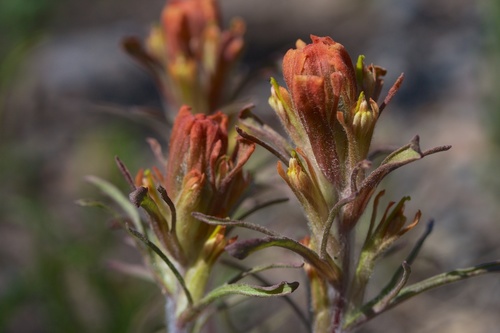
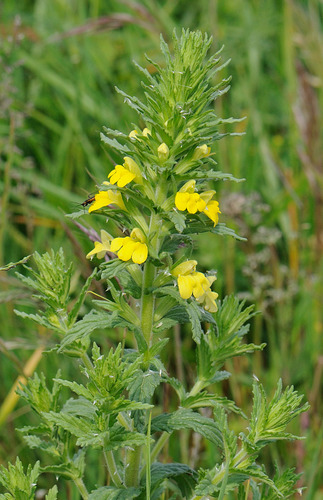
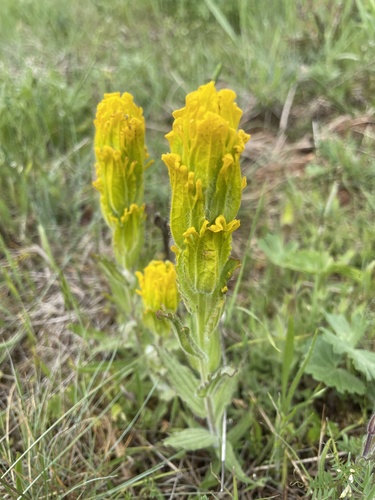
Castilleja levisecta, commonly called golden paintbrush, was first collected as a modern botanical specimen near Mill Plain, Washington by Thomas Jefferson Howell in 1880, and formally described by Jesse More Greenman in 1898. It is a perennial herb that grows in clumps containing up to fifteen stems. Though its green leaves contain chlorophyll for photosynthesis, like other species in the Castilleja genus it is a hemiparasite: it uses haustorial connections to tap the roots of other plants to obtain additional nutrients and water. Its inflorescence holds bright golden yellow bracts, with small green flowers tucked between these bracts. Within its Pacific Northwest range, it is the only Castilleja species that has yellow bracts. Golden paintbrush is thought to be pollinated by bumblebees, including the species Bombus californicus. The species is nearly self-incompatible, and produces far more seeds when crossed with a less closely related individual, such as a plant from a separate population. It is known to hybridize with Castilleja hispida (harsh paintbrush) and produce viable seed in laboratory and experimental grassland settings. Golden paintbrush grows in low-elevation prairie habitat, typically in gravelly sediment deposited by glaciers. It often grows alongside Idaho fescue (Festuca idahoensis) and red fescue (Festuca rubra), and is a member of the Garry Oak ecosystem. All remaining Canadian occurrences of the species are found on Trial Island and Alpha Islet off the coast of Vancouver Island. There are nine populations in Washington, located in maritime grasslands and bluffs around Puget Sound; most of these populations grow on islands, including several on Whidbey Island and one on San Juan Island. This diploid species has very high genetic diversity for a rare plant, a trait that reduces its likelihood of rapid extinction. Conservation efforts are currently active, particularly focused on increasing populations by introducing and reintroducing plants to suitable habitat, and carefully augmenting existing populations by planting more individuals. Golden paintbrush has been reintroduced to its former native range in Oregon's Willamette Valley, and these reintroduced populations will be monitored long-term, ideally for over twenty years, to assess their health and status. Golden paintbrush plays an important role in grassland community dynamics and multitrophic interactions. Its hemiparasitic reliance on other plants in its habitat is thought to impact competition and species dominance among other plants in the community. Additionally, its foliage naturally produces defensive compounds called iridoid glycosides, which are sequestered in the tissues of endangered Taylor's checkerspot butterfly larvae. These larvae have evolved tolerance to the compounds and can eat golden paintbrush foliage, and the stored iridoid glycosides provide the larvae with chemical protection against bird predators. The grassland habitats where golden paintbrush grows have historically experienced periodic wildfires, and golden paintbrush appears to thrive under this fire regime. This may be because fires remove taller vegetation that would otherwise compete with it, or fire ash adds nutrients to the soil. Fire frequency may also affect the species' defensive phytochemistry. Because golden paintbrush is fire-adapted, fire suppression efforts cause it negative impacts. Other threats to the species include habitat destruction from residential and other development, and encroachment by introduced plant species such as mouse-ear hawkweed (Hieracium pilosella), Scotch broom (Cytisus scoparius), and oxeye daisy (Leucanthemum vulgare). Populations also face losses from herbivory by wild animals, trampling by hikers, and picking by wildflower enthusiasts. The ability of golden paintbrush to hybridize with harsh paintbrush has been identified as a threat to the genetic integrity of golden paintbrush, so land managers must develop strategies to balance the ecological needs of these two Castilleja species and the endangered insects that depend on them.