About Castilleja integra A.Gray
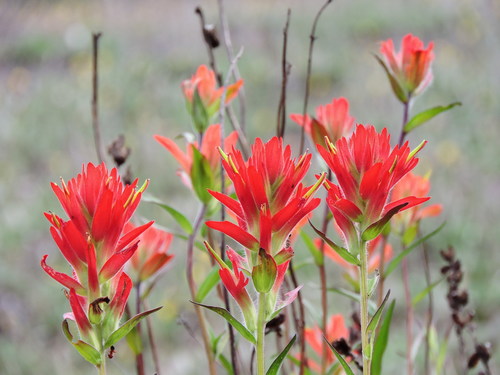
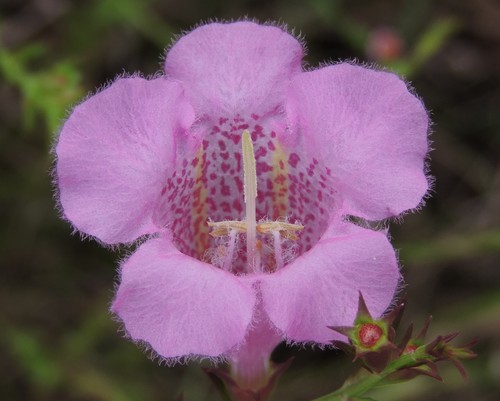
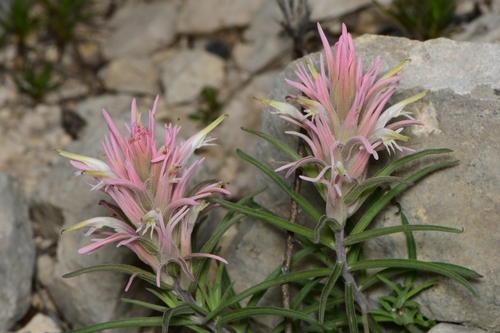
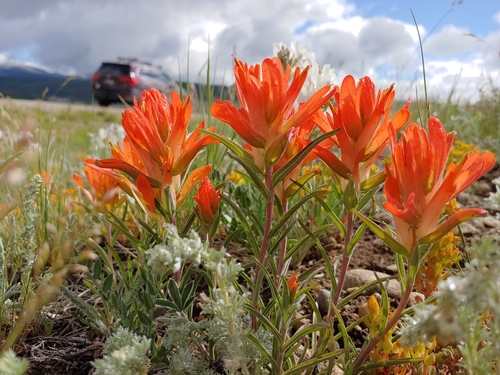
Mature Castilleja integra typically grow 9–50 centimeters (3.5–20 in) tall, though they have been recorded reaching 100 centimeters (39 in). All above-ground plant parts (leaves, bracts, stems, and flowers) are covered in a light coating of soft down, called tomentum by botanists. Herbaceous stems regrow each season from a hard, woody structure called a caudex that sits atop a substantial taproot or stout branched roots. Stems are either erect (growing straight up from the ground) or ascending (curving at the base to grow outwards a short distance before growing upwards). C. integra may produce a single solitary stem or multiple stems; stems are always unbranched near the base, but may develop short branches near their tips. Leaves of Castilleja integra range in color from purplish to fully green, but usually appear pale or dusty due to fine, unbranched surface hairs. Leaves are always narrow, and vary from very thin and grass-like (linear leaves) to almost rectangular, but still not very wide (narrowly oblong leaves). Leaves are usually entire (without divisions or toothed edges), but occasionally develop two shallow divisions near the tip, creating three lobes. Leaf edges may be wavy, but leaves are never thick or fleshy, and often roll inward toward the leaf center (involute). Leaf tips are either narrowly pointed or slightly rounded. Leaves can grow 1–9 centimeters (0.39–3.5 in) long, but most are 2–7 centimeters (0.79–2.8 in) long. The inflorescence (cluster of flowers and surrounding bracts) can be 2 to 15 centimeters long, though usually it is shorter than 10 centimeters, and 1.5–4 centimeters (0.59–1.6 in) wide. The showy bracts are variable in color: occasional individuals have rose, crimson, cerise, pale salmon, or pale yellow bracts, but most often bracts are an intense red-orange or orange flame color. Most often the entire bract is the same color, but sometimes bract bases are green or pale straw color. Bracts may be shaped like a narrow spear point (lanceolate), oblong similar to the leaves, egg-shaped (obovate), or intermediate between any of these shapes. Bract tips can be undivided, or have three or (rarely) five lobes. The central or single lobe tip is always blunt, while any present side lobes have narrow, acute tips. Bracts measure 20 to 40 millimeters in total length. The sepals (calyx) share the same color and texture as the bracts, and measure 18–38 millimeters long, most often 21 to 35 millimeters. Sepals are united into a tube for most of their length, with splits toward the tip. Splits on the top and bottom of the tube make up 25–35% of the total tube length, reaching 6–18 millimeters long, and most often 9–16 millimeters. Side splits are shorter, making up 10–15% of the tube length. The lobes formed by the splits are lanceolate or triangular in shape, with either rounded or narrow tips. Castilleja integra has true petals that are fused into a tube for most of their length. Total petal length is usually 25–45 millimeters, and may be as short as 21 millimeters or as long as 50 millimeters in exceptional cases. The tube portion of the petals measures 17–33 millimeters long. The beak, the pointed end of the petals, is green on its upper surface, and ranges from slightly shorter than the sepals to projecting well past them. The beak measures 8–18 millimeters long, most often 10–17 millimeters. The lower lip is always dark green and 20% as long as the beak. The flowering season is very extended due to the wide range of elevations this species occupies; flowering occurs most often from March to October, but occasionally starts as early as January. In Colorado, the blooming season runs from June through August. Seeds develop inside a capsule 12–16 millimeters long. Castilleja integra may be confused with the similar species Castilleja lanata and Castilleja miniata. A combination of undivided leaves that strongly roll inward (involute), soft unbranched downy hairs, and usually undivided bracts distinguishes Castilleja integra from its close relatives. The natural range of Castilleja integra broadly covers northern Mexico and the southwestern United States. In the United States, it grows in Arizona, Colorado, New Mexico, and Texas, and does not occur in California or Nevada. It also grows across much of northern Mexico, including the states of Baja California, Sonora, Chihuahua, Coahuila, Nuevo León, Tamaulipas, and Durango. It occurs across a very wide elevation range, most often between 1,000 and 3,300 meters (3,300 to 10,800 ft), and may occasionally be found as low as 600 meters (2,000 ft). Castilleja integra grows in a variety of wild habitats including open grasslands, dry meadows, Madrean pine–oak woodlands, open pinyon–juniper woodlands, and subalpine meadows. It is not typically found in cool, moist habitats like aspen woodlands. This species is at least somewhat fire adapted; one study found no local extirpation after low intensity wildfires, and only small levels of extirpation after moderate intensity fires. Caterpillars of the variable checkerspot butterfly (Euphydryas chalcedona) feed on various species in the Orobanchaceae and Scrophulariaceae families, including Castilleja integra. The visually similar leanira checkerspot (Chlosyne leanira) is more selective: it is only recorded feeding on plants in the paintbrush genus Castilleja, and very often feeds on Castilleja integra in southern Colorado. Hummingbirds are frequent pollinators of Castilleja integra, including the rufous hummingbird, broad-tailed hummingbird, and black-chinned hummingbird. Each flower produces about 2 milligrams of sugar in its nectar per day, attracting pollinators to the nectar concealed within the long flower tube. Pollen is deposited on the hummingbirds' bills and crowns. Both sexes of rufous hummingbirds fiercely defend territories containing blooming C. integra, or attempt to steal established territories. They maintain roughly the same number of flowers in their territories, and only abandon a territory when displaced by aggression or as flower numbers decrease. Castilleja integra is considered a hemiparasite, because seedlings can sprout without a host plant and the species can photosynthesize to produce at least some of its own energy. However, it is partially dependent on a host plant for healthy growth, and potted tests found it cannot survive longer than three months without a host. Both plant size and survival improve when a host plant is present. Known compatible host plants include Artemisia frigida, Artemisia michauxiana, Calylophus serrulatus, Ericameria nauseosa, Liatris punctata, Oxytropis sericea, Penstemon pinifolius, Penstemon attenuatus, Penstemon strictus, Penstemon teucrioides, Eriogonum strictum, and Eriogonum jamesii. When Castilleja integra was planted with Campanula petiolata, Erigeron elatior, Penstemon virens, Tetraneuris scaposa, or Liatris spicata as potential hosts, no plants survived 14 months in field plantings. When planted with Antennaria media, 3% of plants survived to 14 months; when planted with Zinnia grandiflora and Penstemon crandallii, 17% survived 14 months. When grown in pots with potential hosts, C. integra had 10% or less survival after three months when paired with Eriogonum umbellatum var. dichrocephalum, Gaillardia spathulata or Geum triflorum. Similarly, silvery lupine (Lupinus argenteus) does not support Castilleja integra very readily: only one out of forty pairings bloomed in a 2004 one-year test. Paintbrush species including Castilleja integra are desirable in gardens for their showy flowers and ability to attract hummingbirds, but can be difficult to grow due to their dependence on a host species and dislike of transplanting. This means nursery-grown plants for sale must be grown with a compatible host plant in the same pot, that is also appealing to garden buyers. Orange paintbrush (the common name for Castilleja integra) and desert paintbrush (Castilleja chromosa) are two of the most tolerant species of garden conditions and transplanting. The highest potted survival rates for orange paintbrush occur when grown with fringed sagebrush, lemon sagewort, rubber rabbitbrush, pine-leaved penstemon, yellow sundrops, Blue Mountain buckwheat, or antelope sage. Among penstemon species, Penstemon strictus produces some of the best survival rates. Distance from the host plant also affects survival: survival falls by more than 80% when C. integra is placed 4 centimeters from the host instead of just 2 centimeters. Gardening sources often list grasses as host plants for paintbrush, and Bouteloua gracilis is recommended in gardening books. Established plants rarely survive transplanting, so they are generally not moved in gardens or transplanted from the wild. Orange paintbrush grows best in unproductive, low-organic-matter soils that drain very well. It has proven adaptable to parasitizing non-native host species, such as sheep fescue. Orange paintbrush can grow in regions as cold as USDA zone 4 (minimum temperatures of −34.5 to −29 °C / −30 to −20 °F) and as warm as USDA zone 8. The Zuni people used the bark of this species' root, mixed with minerals, to dye deerskin black.