About Castilleja hispida Benth.
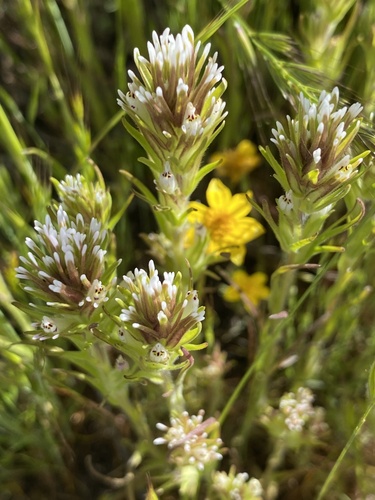
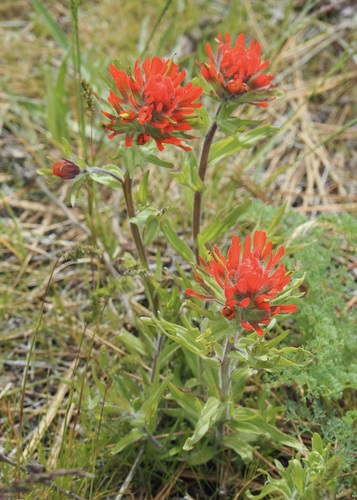
Castilleja hispida Benth., commonly known as harsh paintbrush, grows at low to middle elevations in open areas, most typically on grassy slopes, dry meadows, forest edges, and forest openings. It is a perennial herb that grows in clumps with several ascending or erect hairy stems. These stems are usually unbranched and can reach up to 60 centimeters tall. Its leaves are green and contain chlorophyll for photosynthesis, but like other species in the Castilleja genus, it is a hemiparasite. It forms haustorial connections to tap into the roots of other plants to obtain nutrients and water. Its inflorescence holds bright orange to red bracts, with small green flowers tucked between these bracts. Harsh paintbrush is pollinated by bees of the Bombus genus. Populations of this species may be diploid or tetraploid, though diploid populations are far more common. This species, especially in its diploid form, can hybridize with the diploid Castilleja levisecta (golden paintbrush) and produce viable seed in laboratory settings and experimental grassland restoration sites. This ability to hybridize is recognized as a threat to the genetic integrity of the endangered golden paintbrush, meaning land managers must develop strategies to balance the ecological needs of both Castilleja species and the endangered insects that rely on them. In ecological communities, harsh paintbrush plays an important role in grassland multitrophic interactions. Its foliage naturally produces defensive compounds called iridoid glycosides. Endangered Taylor's checkerspot butterfly larvae can tolerate these compounds, consume harsh paintbrush foliage, and sequester the iridoid glycosides in their tissues. The sequestered compounds then provide the butterfly larvae with chemical protection against bird predators. Harsh paintbrush is also one of the preferred plant species for female Taylor's checkerspot butterflies to lay their eggs.