About Castilleja grisea Dunkle
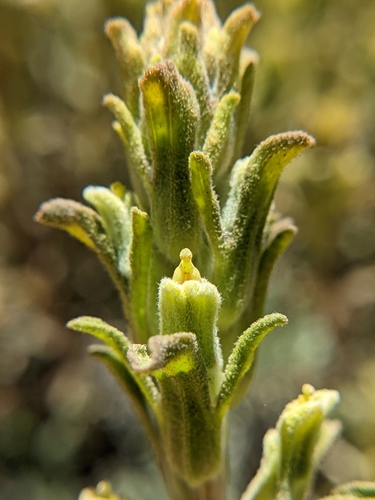
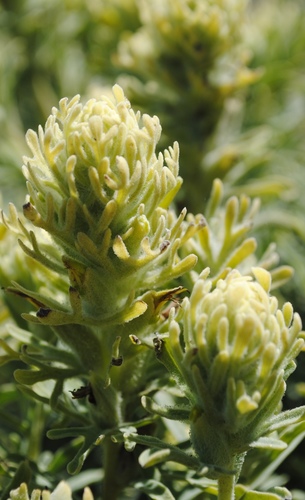
Castilleja grisea, commonly known as the San Clemente Island Indian paintbrush, is a perennial herb densely covered in long gray hairs. Its highly branched stem reaches 40 to 60 centimeters tall and bears linear leaves that are each a few centimeters long. Its inflorescence consists of layers of bracts 1 to 2 centimeters long; these bracts are gray-green at the base and tipped with greenish yellow. Dull yellow, pouched flowers emerge between the bracts. The fruit is a capsule approximately one centimeter long, holding tiny seeds with net-like surfaces. This species is endemic to San Clemente Island. It was once considered relatively common on the island, but its habitat has since become severely degraded, primarily by introduced feral goats. The island was also used for sheep and cattle grazing, and feral pigs were also present on the island. While these animals may have eaten the plant occasionally, their main impact was damaging the land through trampling, which caused soil compaction, topsoil loss, and erosion. The introduction of exotic plant species including ripgut brome (Bromus diandrus), wild oat (Avena barbata), and red brome (Bromus madritensis rubus) further degraded the species' habitat. Due to the steep terrain of San Clemente Island, the exact current abundance of Castilleja grisea is unknown. However, recent surveys have found new populations of the species, and 2007 surveys estimated there are more than 10,000 existing plants. This species has been a federally listed endangered species since 1977, when it was one of the first species to receive this designation. Its population was drastically reduced by the activity of feral goats, but populations have increased at least ten-fold since these non-native herbivores were removed. Through management programs run by the Navy, the species has recovered well enough that it was recommended for downlisting during the most recent review by the United States Fish and Wildlife Service. Remaining threats to the species include erosion, invasive grasses, and wildfire from military exercises. As an uncommon island endemic, it has relatively high genetic variability. This characteristic, along with its steady recovery from low population numbers, gives an optimistic outlook for the species' long-term recovery.