About Castilleja coccinea (L.) Spreng.
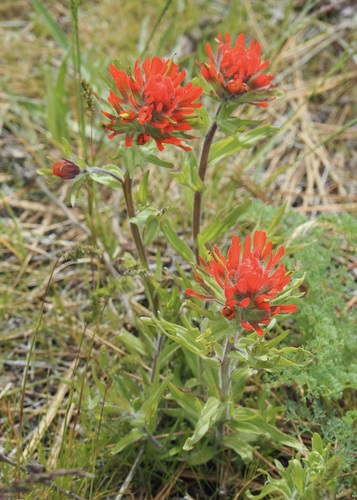
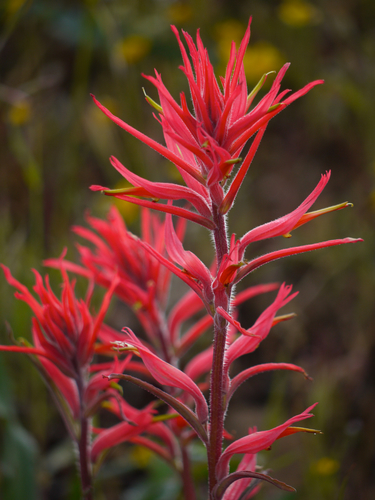
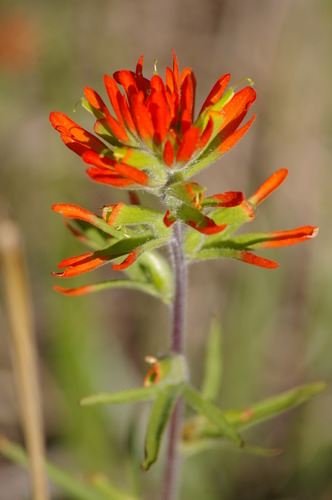
Castilleja coccinea (L.) Spreng. is an upright, hairy, hemiparasitic plant that grows 1 to 7 decimeters (3.9 to 27.6 inches) tall. In its first year of growth, the plant forms a basal rosette; in the second year, an usually unbranched stem grows from the rosette. Basal leaves are oblong, mostly have smooth untoothed margins, and typically die before flowers bloom. Alternate stem leaves are deeply and irregularly lobed, and can reach up to 8 cm (3 inches) in length. This plant's common names refer to its showy red bracts; the actual small flower, with a greenish-yellow corolla, sits inside these bracts. Castilleja coccinea can be told apart from other Castilleja species in the southeastern U.S. by three key features: it has a 2-to-3.5-millimeter (0.08 to 0.14 inch) long thin yellowish or orangish lip on its corolla, deeply lobed inflorescence bracts, and usually well-developed basal leaf rosettes.
Castilleja coccinea is native across central and eastern United States, ranging west to Oklahoma, south to Florida, east to Maine, and north to the Canadian border. Within the U.S., it is listed as endangered in New York, Connecticut, and Maryland. It is considered critically imperiled in New Jersey, West Virginia, Kentucky, Georgia, Alabama, and Mississippi. It is presumed extirpated in Maine and New Hampshire, and possibly extirpated in Louisiana, Massachusetts, and Rhode Island. In Canada, it is native to Saskatchewan, Manitoba, and Ontario, and is critically imperiled in Saskatchewan. It grows in prairies, rocky glades, moist open woodlands, thickets, and along stream banks.
Castilleja coccinea exhibits color polymorphism: individuals can have yellow or scarlet coloration, a difference tied to local pollinator availability. When pollinators like bees are abundant, scarlet Castilleja coccinea have higher reproductive output, producing more seeds and fruits. When pollinators are scarce, yellow Castilleja coccinea have higher reproductive output instead. While this species can survive without a host, studies show its growth increases by forty times when its roots parasitize the roots of other plants to obtain nutrients. It is primarily pollinated by ruby-throated hummingbirds, which can carry pollen long distances between the plant's usually small and scattered populations.