About Castilleja chromosa A.Nelson
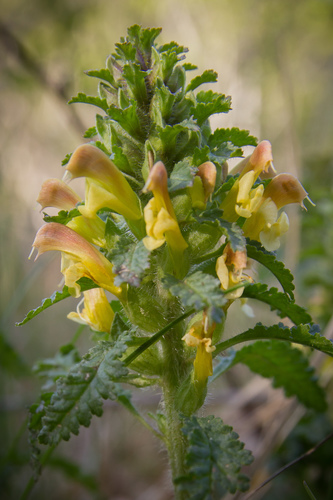
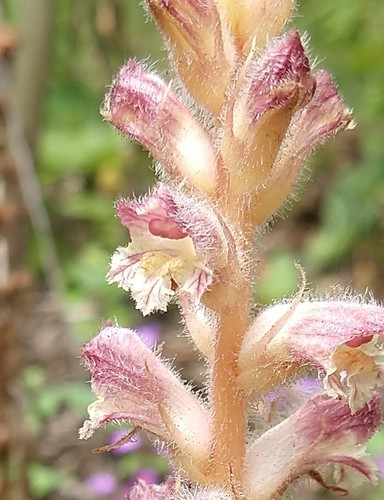
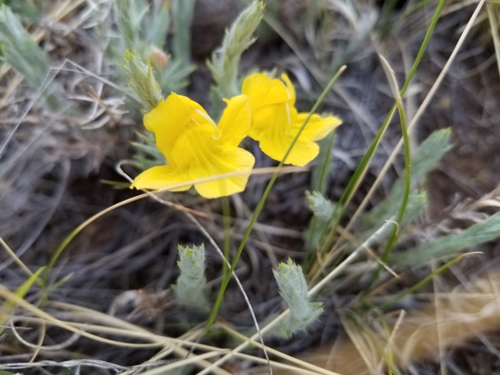
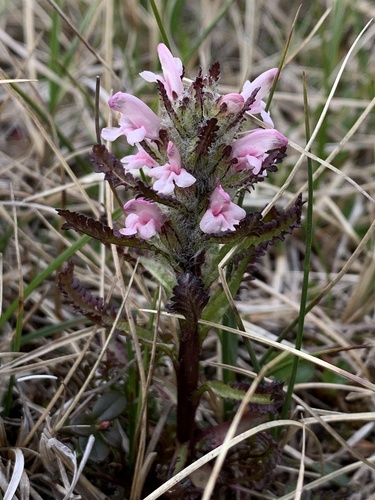
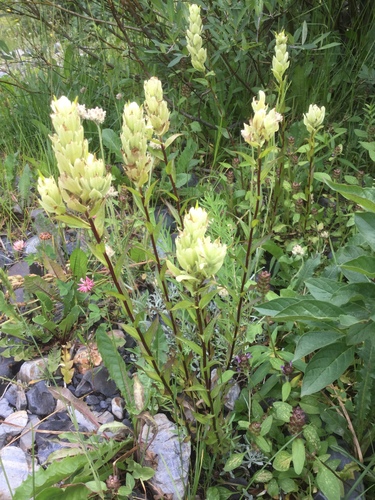
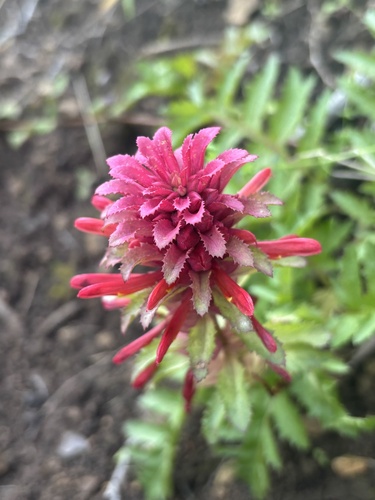
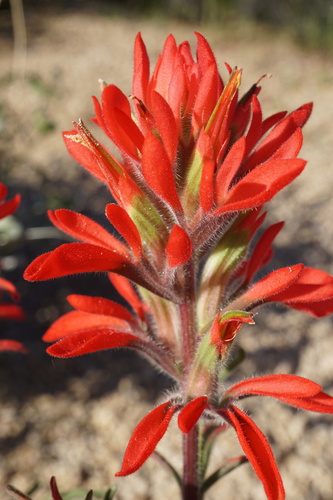
Commonly called desert paintbrush, Castilleja chromosa A.Nelson is a gray-green perennial that sometimes grows as a subshrub, with partly woody stems especially at their bases. Underground, this species has a thick taproot topped by a woody caudex. Plants grow 15 to 35 centimeters (0.5 to 1.1 feet) tall on average, and may reach 45 centimeters (1.5 feet) tall when growing in good conditions. They often produce many straight to slightly curved, clustered stems that rarely branch in their upper sections, and stems are more or less covered in bristly hairs. Leaves attach alternately to stems and range from 1.5 cm (0.6 in) up to 7 cm (2.8 in) long, most often falling between 2.5 and 6 cm (1.0 and 2.4 in). Leaves can be linear (narrow like a grass blade), lanceolate (shaped like a spear head), or oblanceolate (a reversed spear shape with the widest portion past the midpoint). Like this species' bracts, leaves are divided into lobes: most often three or five lobes, sometimes up to seven lobes, and occasionally no divisions at all. Desert paintbrush blooms between May and September, and produces large, colorful inflorescences that are 2.5 to 15 centimeters (1 to 6 inches) long and 1.5 to 5.5 cm (0.6 to 2.2 in) wide. Inflorescences are covered in hairs ranging from coarse (hirsute) to occasionally long and soft (pilose). The brightly colored parts of the inflorescence are bracts, which are often mistaken for petals. The upper half of the bracts is orange or bright red, and occasionally yellow, dull orange, or soft pink. Bract bases are more often green or muted purple, and bract tips are never purple. Each bract usually has three, five, or seven primary lobes; rarely, bracts have no divisions, or primary lobes may divide further into smaller secondary lobes. The actual flowers of Castilleja chromosa are yellowish-green with more or less reddish edges, tubular, and unremarkable in appearance. The whole flower is 2.1 to 3.2 cm (0.8 to 1.3 in) long. The lower lip of the floral tube is reduced, dark green, and has incurving teeth, while the upper beak makes up more than half the flower's total length. As flowering ends and seeds develop, the inflorescence grows much longer. Fruits of this species measure 1 to 1.5 centimeters (0.4 to 0.6 in) long, and seeds measure 2 mm (0.08 in). Ripe seeds have a wrinkled, net-like surface texture. Desert paintbrush is distributed across ten western US states. In California, it grows mostly east of the Cascade Range, Sierra Nevada, San Bernardino Mountains, and San Jacinto Mountains. It is mostly native to eastern Oregon, with only a few recorded occurrences west of the Cascades. It grows across most of Idaho, but the USDA Natural Resources Conservation Service does not record its exact distribution in Montana and Wyoming. No exact locations are recorded for Nevada, but it grows in every county of Utah. In Colorado, it occurs mostly west of the Rocky Mountains. It also grows in the northwestern quarter of New Mexico, and in all but the southernmost counties of Arizona. This species grows in multiple habitat types including sagebrush steppe, blackbrush scrub, piñon–juniper woodlands, and juniper woodlands. It occupies a wide elevation range, from 500 to 3,200 meters (1,600 to 10,500 ft). Like many other members of its genus, Castilleja chromosa is partially parasitic: it uses specialized structures called haustoria to obtain some (but not all) of its required nutrients from other plants. Common host plants include big sagebrush and other species in the aster family. One study of this species parasitizing big sagebrush found that desert paintbrush obtains roughly 10% of its sugar energy from its host. In controlled experiments, desert paintbrush—alongside the related species Castilleja integra (orange paintbrush) and Castilleja scabrida (rough paintbrush)—was found to tolerate periods without a host for short lengths of time. Desert paintbrush is a selenium hyperaccumulator. Its pollinators include butterflies, hummingbirds, and bees.