About Castanospermum australe A.Cunn. ex Mudie
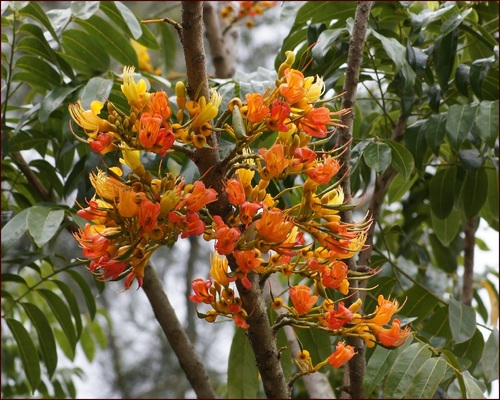
Castanospermum australe A.Cunn. ex Mudie, commonly called black bean, is a large evergreen tree that can reach up to 40 m (130 ft) tall, though most mature individuals are much smaller. Its leaves are pinnate, measuring 15 cm (5.9 in) long and 6–7 cm (2.4–2.8 in) wide, and hold between 11 and 15 leaflets. The species produces bicoloured red and yellow flowers that are 3–4 cm (1.2–1.6 in) long, arranged in racemes 6 cm (2.4 in) long. Its fruit is a cylindrical pod 12–20 cm (4.7–7.9 in) long with a 4–6 cm (1.6–2.4 in) diameter; the inside of the pod is split by a spongy substance into 1 to 5 cells, each holding a single large chestnut-like seed. This species is native to eastern Australia, and the islands of Vanuatu and New Caledonia, where it grows in rainforest and gallery forest, especially along water courses. In its native Australian range, it occurs from Kutini-Payamu National Park (formerly Iron Range National Park) south to approximately Coffs Harbour, growing at altitudes from sea level up to around 800 m (2,600 ft). It has been introduced to many regions across the world, including India, Malaysia, Papua New Guinea, Sri Lanka, South Africa, and the United States. Unprocessed seeds of Castanospermum australe are poisonous, as they contain toxic saponins that can cause vomiting and diarrhoea. When carefully prepared via roasting, cutting into small pieces, leaching with running water for several days, pounding into flour, and roasting again to make damper, the seeds become edible. Indigenous peoples have prepared and eaten these seeds for at least 2,500 years, and this traditional use was recorded and described in the 1889 book The Useful Native Plants of Australia. As of 2012, this seed was not used in modern bush tucker, and no nutritional information about the seeds was available. The species is widely cultivated: it is popular as a potted houseplant in Asia, Europe, and America, and grown as a shade tree for parks across Australia and many other countries.