About Cassinia trinerva N.A.Wakef.
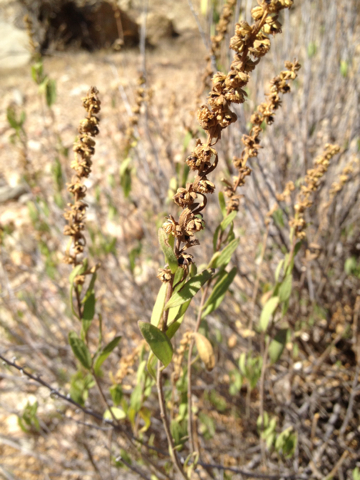
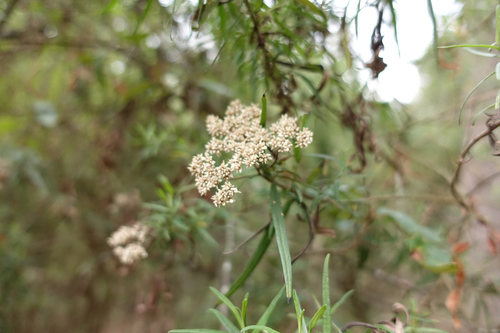
Cassinia trinerva N.A.Wakef. is an erect shrub or tree that typically grows to a height of up to around 8 meters (26 feet). Its branchlets are sticky, and covered in a mix of glandular and cottony hairs. The leaves are narrow lance-shaped, measuring 30 to 120 mm (1.2 to 4.7 inches) long and 3.5 to 6 mm (0.14 to 0.24 inches) wide, growing on a 1 to 4 mm (0.039 to 0.157 inch) long petiole and featuring three longitudinal veins. The upper surface of the leaf is slightly sticky, while the lower surface is covered in cottony hairs. The flower heads measure 2.5 to 3.5 mm (0.098 to 0.138 inches) long and 1 to 1.5 mm (0.039 to 0.059 inches) wide, each holding three or four white florets. These florets are surrounded by 14 to 18 involucral bracts arranged in three to five whorls. The flower heads are crowded together in dense corymbs that are 60 to 120 mm (2.4 to 4.7 inches) in diameter. Flowering takes place from December to March. The achenes this species produces are 0.5 to 1.0 mm (0.020 to 0.039 inches) long, with a pappus that is 2.0 to 2.5 mm (0.079 to 0.098 inches) long. This species of cassinia grows as an understorey shrub in tall forests, along the edges of rainforests, and on dry rocky sites. It can be found in south-eastern Queensland, on the coast and tablelands of New South Wales south of Bolivia, in south-eastern Victoria, and in north-eastern Tasmania.