About Cassinia aculeata (Labill.) R.Br.
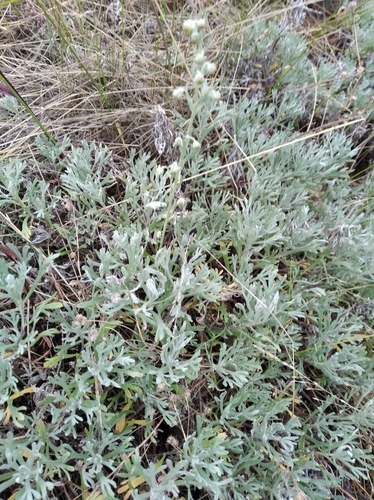
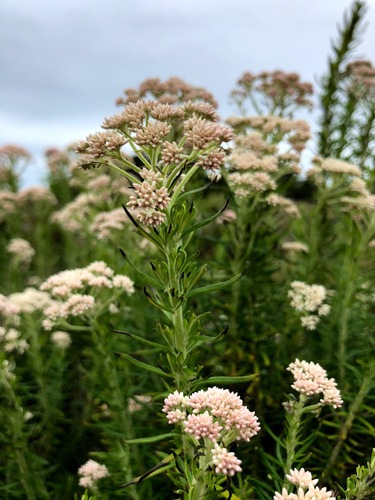
Cassinia aculeata (Labill.) R.Br. is an erect shrub that usually reaches a height of 1 to 2.6 metres (3 feet 3 inches to 8 feet 6 inches). Young stems of this species are densely hairy, while older branches have flaky bark. Its leaves are sessile and linear, measuring 3 to 50 millimetres (0.12 to 1.97 inches) long and 0.7 to 2.0 millimetres (0.028 to 0.079 inches) wide, and often have rolled-under edges. The flower heads of Cassinia aculeata range in colour from creamy-white to white, are 4 to 5 millimetres (0.16 to 0.20 inches) long, and arranged in rounded cymes holding 30 to 200 flower heads. The cymes themselves are 20 to 130 millimetres (0.79 to 5.12 inches) in diameter. Flowering takes place from November to February, and the fruit is a cylindrical achene 0.8 to 1.0 millimetre (0.031 to 0.039 inch) long, topped with a pappus of barbed bristles that is 2.5 to 3.5 millimetres (0.098 to 0.138 inch) long. This plant grows in a wide range of habitats, from sea level up to 1,300 metres (4,300 feet) above sea level, and often grows in disturbed areas such as sites after fire or logging operations. It occurs naturally in New South Wales, the Australian Capital Territory, Victoria and Tasmania. The subspecies C. aculeata subspecies nova-anglica grows at higher altitudes, and is only known from New England National Park and a single collection made on the Central Tablelands. In horticulture, this species grows quickly. It needs heavy, moist, well-drained soils and a position in partial sun, and cannot tolerate salt winds. It can be used to form a quick screening hedge while slower growing plants mature. It is not usually a long-lived plant. Cassinias require pruning to keep their desired shape. The flowers of this species are long-lasting, and can also be dried for use. Contact with the foliage may cause skin irritations.