About Cassida viridis Linnaeus, 1758
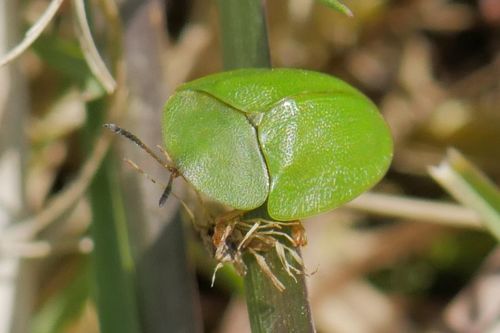
Cassida viridis reaches a body length of 8.5 to 10 millimetres (0.33 to 0.39 inches). It has an unusually flat, oval-shaped body. The thorax and elytra are green, and lack the markings that are characteristic of other species in the Cassida genus. The punctation on the elytra is fully uniform. Both the legs and the rather short, threadlike antennae are brown, while the underside of the body is black. These highly camouflaged beetles are active and can be found from April through October. They typically remain on their host food plants, which are mostly various species of mint, including Mentha aquatica, Mentha arvensis, Mentha longifolia, Mentha rotundifolia, Mentha suaveolens, and Mentha verticillata. They also feed on other plants in the Lamiaceae family, such as Galeopsis grandiflora, Galeopsis speciosa, Galeopsis tetrahit, Galeopsis pubescens, Melissa officinalis, Salvia glutinosa, Salvia officinalis, Salvia pratensis, Stachys palustris, Stachys recta, and Stachys sylvatica. The larvae of Cassida viridis are very spiny. To protect themselves from enemies and parasites, they typically carry their own excrement on two spines located on their upper side, a structure called a fecal shield. This species is native to most of Europe, the eastern Palearctic realm, the Near East, and North Africa. It was introduced to southern Ontario, Canada, and this introduced presence, dating back as early as 1974, was only discovered recently.