About Cassia fistula L.
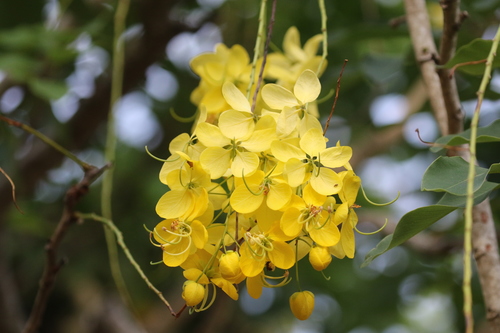
Cassia fistula L., commonly called the golden shower tree, is a fast-growing, medium-sized tree that reaches 10–20 m (33–66 ft) in height. It has deciduous pinnate leaves 15–60 cm (6–24 in) long, with three to eight pairs of leaflets; each individual leaflet is 7–21 cm (3–8 in) long and 4–9 cm (1+1⁄2–3+1⁄2 in) broad. The tree produces flowers in pendulous racemes 20–40 cm (8–16 in) long; each flower is 4–7 cm (1+5⁄8–2+3⁄4 in) in diameter, with five equal-sized, equal-shaped yellow petals. Its fruit is a legume 30–60 cm (12–24 in) long and 1.5–2.5 cm (9⁄16–1 in) broad, with a pungent odor and containing multiple seeds. The golden shower tree produces strong, very durable wood; the heartwood of this species, known as ahala, ehela, or aehaela (ඇහැල in Sinhala), was used to construct Ehela Kanuwa, a site at Adam's Peak, Sri Lanka. Unlike some related species, it is not a nitrogen fixer. Cassia fistula is widely cultivated as an ornamental plant in tropical and subtropical regions. It blooms in late spring to early summer during hot, dry weather. Flowering is very abundant, and trees become covered in yellow flowers, often with almost no leaves visible. It grows well in dry climates, and grows best in full sun on well-drained soil. It is relatively drought-tolerant and slightly salt-tolerant. It can withstand light, brief frost, but suffers damage if cold conditions persist. It may develop mildew or leaf spot, especially during the second half of the growing season. It blooms better when there are pronounced temperature differences between summer and winter. It is used as a traditional iconic element during Vishu festivals in Kerala, India. As a food source, golden shower tree flowers are sometimes eaten by people in India. Its leaves are also used to supplement the diets of cattle, sheep, and goats that are fed low-quality forage. In Ayurvedic medicine, the golden shower tree is called aragvadha, which means 'disease killer'. Its fruit pulp is classified as a purgative, and Ayurvedic texts strongly advise against self-medication or any use without medical supervision. Although it has been used in herbal practices for thousands of years, little modern research has been done on it; it is still an ingredient in some mass-produced herbal laxatives, where it is known as 'cassia pods'. In developing countries, approximately 80% of the population prefers using traditional medicine to address primary health symptoms. Many local people, especially in Asian communities, consider plant-derived medicines, drugs, and other herbal formulations to be lower risk and have fewer side effects than modern medicine. In India, a cathartic made from the tree's fruit pulp is sometimes added to tobacco.