About Caryota urens L.
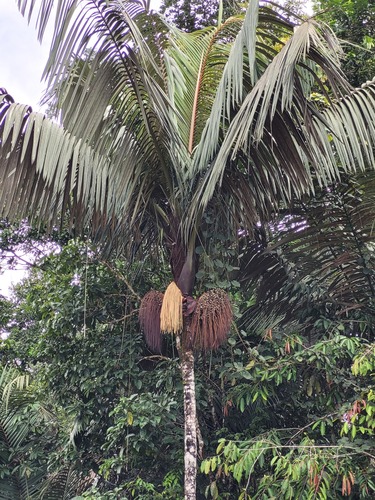
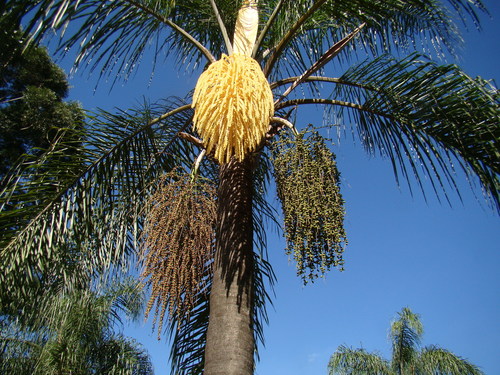
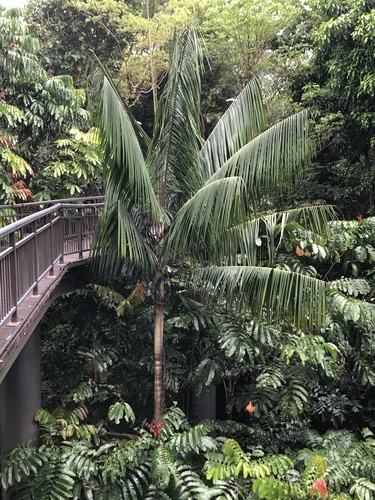
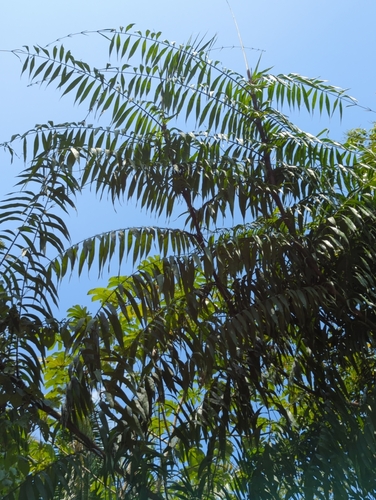
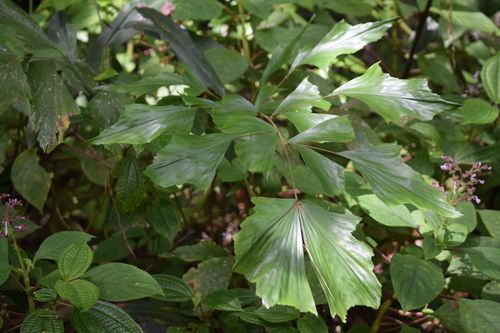
Caryota urens L. is a species of solitary-trunked tree that reaches up to 18 metres (59 feet) in height, with a trunk up to 30 centimetres (12 inches) wide. Widely spaced leaf-scar rings cover its gray trunk, which ends in a leaf crown 6 m (20 ft) wide and 6 m tall. The bipinnate leaves are triangular in shape, ranging from bright to deep green, 3.5 m (11 ft) long, and carried on 60 cm (24 in) long petioles. The obdeltoid pinnae are 30 cm long, with one pointed edge and one jagged edge. 3 m (10 ft) long inflorescences emerge at each leaf node, starting from the top of the trunk and moving downward. These inflorescences produce hanging clusters of white, unisexual flowers. When mature, the fruit is a round, 1 cm (3⁄8 in) red drupe that holds a single seed. Like all species in the genus Caryota, the fruit of this species contains oxalic acid, an irritant to skin and mucous membranes. As this species is monocarpic, the tree dies once it completes flowering and fruiting. The trunk of Caryota urens contains a large amount of starch, and juice can be extracted from the flower shoots. This extracted juice can be boiled to make a sugary syrup. The edible cabbage of the tree can be eaten either raw or cooked. In Sri Lanka, this species is called kithul (කිතුල්), and it is best known as the source of kithul treacle, a type of liquid jaggery. To make kithul treacle, the tree's sap is boiled for many hours until it thickens into a dark, unique treacle that is characteristic of Sri Lanka. Kithul treacle is used as a sweetener in both Sri Lankan and Western cooking. Toddy is extracted from the inflorescence of this tree, and it is considered stronger than toddy extracted from other palm trees. In many parts of western India, this toddy is fermented and distilled to produce a traditional alcohol called 'Maadi'. The pulp of a mature plant can be cut, sun dried, ground into powder, and eaten; this powder is sweet in taste. In the coastal districts of Karnataka, the powder is regarded as cool and nutritious. In Sri Lanka, the powder is mixed with coconut milk and cooked to make Kithul Thalapa (කිතුල් තලප). Elephants are fed both the leaves and pulp of this plant. The leaves contain strong fibers, and are used for basketry in Cambodia, where the species is called tunsaè. The heart of the trunk contains a starch similar to sago, and the trunk itself can be used for building. In Cambodia, when the stiff hairs on the fruit are removed, the fruit is considered pleasant and sweet to eat, and Cambodians also cut the stalks to make sugar, which can then be fermented into wine. Caryota urens is cultivated as an ornamental tree. It is planted in gardens and parks in tropical and subtropical climates, and can also be grown as an interior houseplant when it is small.