About Caryobruchus gleditsiae (Johansson & Linnaeus, 1763)
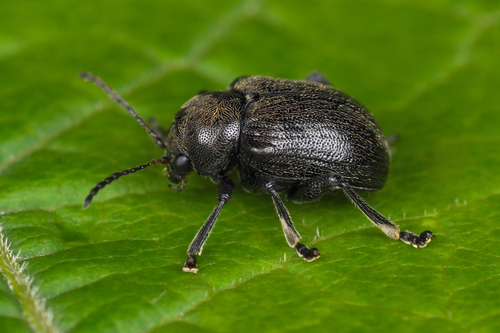
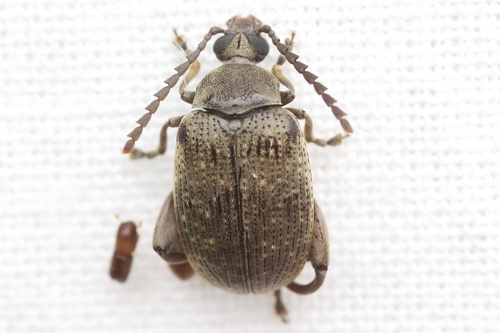
This species has the scientific name Caryobruchus gleditsiae (Johansson & Linnaeus, 1763). Adult beetles of this species measure 4 to 11 millimeters (0.16 to 0.43 inches) in length. An adult's body size depends on the size of the seed that it developed in as a larva. It is the largest species in the family Bruchidae found in the United States, though other species in the same genus can grow up to 25 mm (0.98 in) long. Adult Caryobruchus gleditsiae are black, covered in short grey hairs, and have scattered white spots on their elytra. Caryobruchus gleditsiae is distributed across the southeastern United States, Mexico, Central America, the West Indies, and the Bahamas. A closely related species, Caryobruchus mariae, is found on Cuba. Another closely related species, Caryobruchus maya, occurs in southern Mexico, Belize, and Guatemala. Most members of the beetle subfamily Bruchinae, sometimes referred to as "pea and bean weevils", feed on legumes. In contrast, Caryobruchus and its close relatives in the tribe Pachymerini feed on palm trees, and are commonly called "palm seed weevils". A female Caryobruchus gleditsiae lays one single egg on the outer surface of a palm seed. Females only lay eggs on seeds that have had their exocarp and mesocarp removed, most likely by rodents, to expose the smooth endocarp. After hatching, the larva has sharp, heavy mandibles that it uses to bore into the hard palm seed. Recorded host plants for C. gleditsiae include many species in the palm genus Sabal: S. bermuda, S. causiarum, S. domingensis, S. etonia, S. glabra, S. longipedunculata, S. mexicana, S. minor, S. palmetto, S. parviflora, S. rosei, S. uresana and S. yapa. It also uses other palm species as hosts, including Coccothrinax argentata, Copernicia sp., Phoenix sylvestris, Livistona chinensis, Roystonea sp., Thrinax microcarpa and Washingtonia filifera. C. gleditsiae has no known natural enemies.