About Carya glabra (Mill.) Sweet
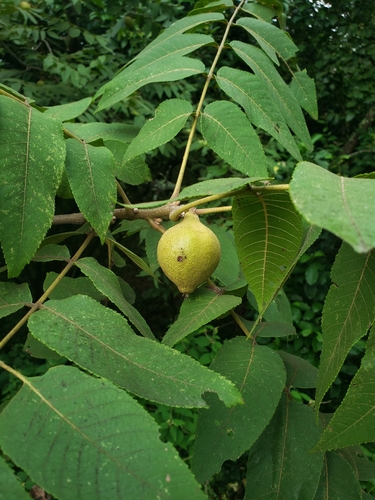
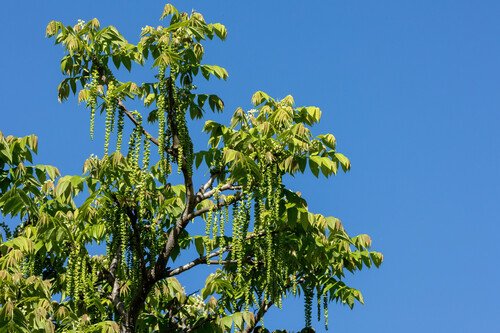
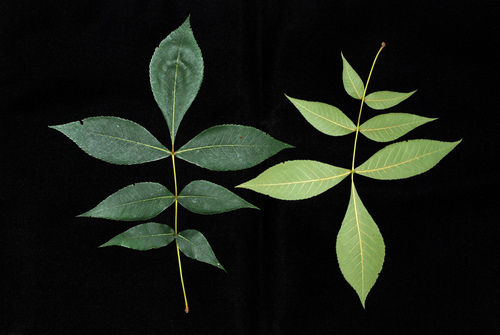
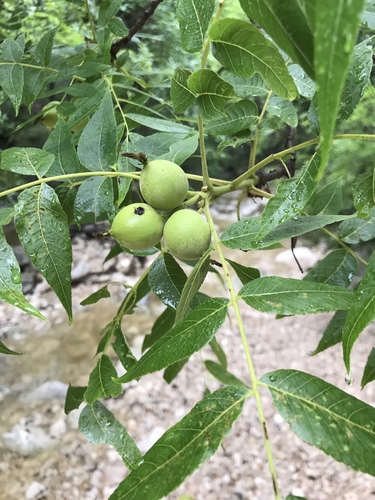
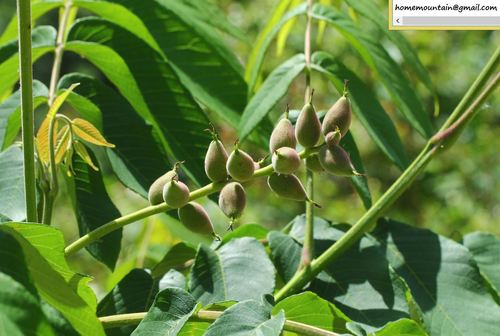
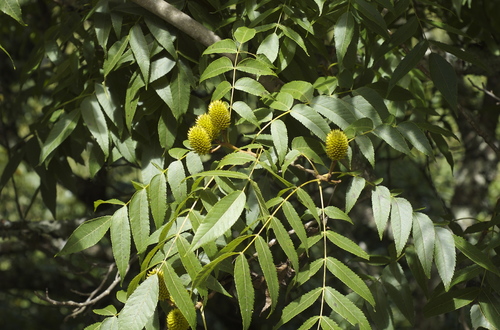
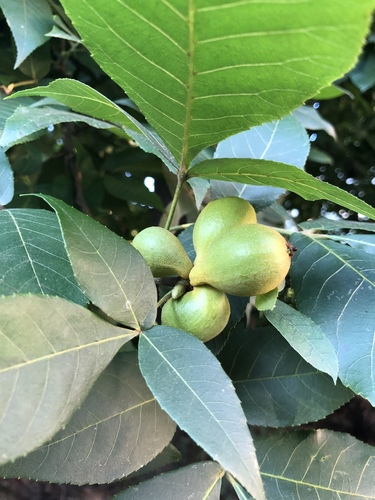
Carya glabra (Mill.) Sweet, commonly known as pignut hickory, is a common but not abundant hickory species found in the oak-hickory forest association of the Eastern United States and Canada. Its other common names include pignut, sweet pignut, coast pignut hickory, smoothbark hickory, swamp hickory, and broom hickory. It has pinnately compound leaves that turn golden yellow in the fall, and some specimens also develop spectacular orangey-red fall colors. Its pear-shaped nut ripens in September and October, has a sweet maple-like scent, and is an important part of the diet of many wild animals. The wood of pignut hickory is used for a variety of products, including home heating fuel. Pignut hickory's native range covers almost all of the eastern United States. It grows from central Florida northward through North Carolina to southern Massachusetts, and also grows north of the Gulf Coast through Alabama and Mississippi, north to Missouri, extreme southeastern Iowa, and the Lower Peninsula of Michigan. The best development of this species occurs in the lower Ohio River Basin, and it outnumbers other hickory species in Appalachian forests. Pignut hickory makes up a large portion of the hickory harvested in Kentucky, West Virginia, the Cumberland Mountains of Tennessee, and the hill country of the Ohio Valley. In Canada, pignut hickory is found only in extreme southern Ontario, with a limited range restricted to the Niagara Peninsula, southern Halton Region, the Hamilton area along western Lake Ontario, southward along the northern shore of Lake Erie, and pockets of extreme southwestern Ontario. Like other hickories, pignut hickory is monoecious and flowers in the spring. Its staminate catkins are 8 to 18 cm (3.1 to 7.1 in) long, and develop from the axils of the previous season's leaves or from inner scales of terminal buds at the base of current growth. Its pistillate flowers grow in spikes around 6 mm (0.24 in) long on peduncles at the end of current year shoots. Flowering occurs from mid-March in the southeastern portion of the range (Florida) to early June in Michigan. Staminate catkins usually emerge before pistillate flowers. The pear-shaped fruit is enclosed in a thin husk that develops from the floral involucre. Fruit ripens in September and October, and seed dispersal takes place from September through December. Husks are green before maturity, turning brown to brownish-black when ripe. They dry out at maturity and split into four valves away from the nut along sutures. For pignut hickory, husks only split to the middle or slightly past the middle, and generally remain clinging to the unribbed nut, which has a thick shell. Hickories, including pignut hickory, sprout easily from stumps and roots. Stump sprouting is less prolific in pignut hickory than in other deciduous tree species, but the sprouts that do grow are vigorous and gain height fairly quickly. Root sprouts are also vigorous, and are likely more numerous than stump sprouts in cut-over areas. Small stumps sprout more often than large stumps. Sprouts that grow at or below ground level, and those from small stumps, are less likely to develop heartwood decay. Pignut hickory is difficult to reproduce from cuttings. In addition to eating its edible nuts, Native Americans used pignut hickory for other culinary purposes. The nuts can be boiled to extract an oil, which can be used as a spread on food or as a hair oil, while the remaining nut meat can be eaten or preserved. Pignut hickory provides food for many types of wildlife. Squirrels of several species are fond of the nuts, which make up an estimated 10 to 25 percent of their diet. In colonial America, hogs were observed eating the nuts, which gave the species its common name. Wild turkeys and several species of songbirds eat the nuts and flowers. Black bears, foxes, rabbits, and raccoons eat the nuts and bark. Small mammals eat the nuts and leaves; hickory nuts make up 5 to 10 percent of the eastern chipmunk's diet. White-tailed deer occasionally browse hickory leaves, twigs, and nuts. The kernel of hickory seeds is exceptionally high in crude fat, reaching 70 to 80 percent in some species. Crude protein, phosphorus, and calcium contents are generally moderate to low, and crude fiber content is very low. Pignut hickory makes up a small percentage of the biomass in low-quality upland hardwood stands, which are often clearcut for chips or fuelwood as a first step toward rehabilitation into more productive stands. Hickory has a relatively high heating value, so it is widely used as home heating fuel. Across most of its range, pignut hickory serves as an important shade tree in wooded suburban areas, but it is rarely planted as an ornamental tree due to its large size and difficulty in transplanting.