About Carrhotus xanthogramma (Latreille, 1819)
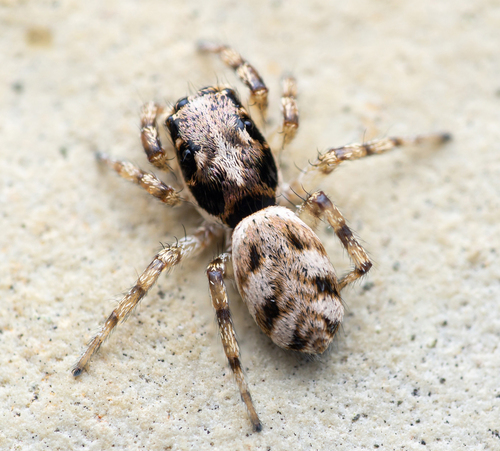
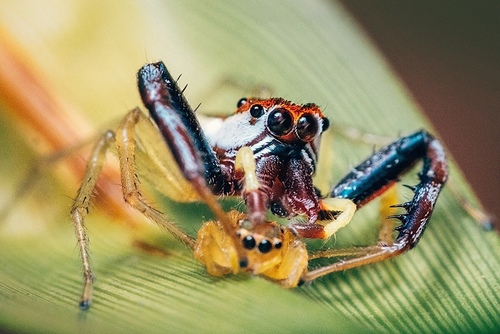
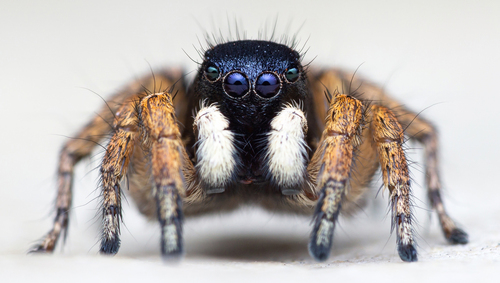
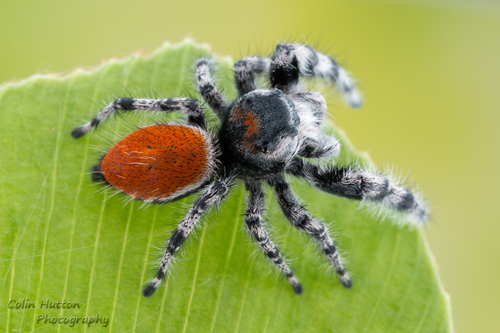
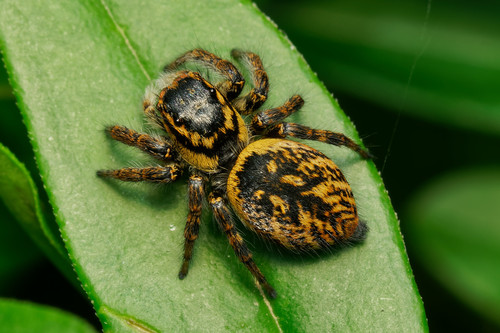
Carrhotus xanthogramma (Latreille, 1819) is a species of jumping spider with pronounced sexual dimorphism. Adult males reach a body length of approximately 5.1–7.1 millimetres (0.20–0.28 in), while adult females reach a body length of about 7.1–9.0 millimetres (0.28–0.35 in), meaning males are smaller than females overall. All individuals of this species are covered in dense hair, and the separation between the cephalothorax (prosoma) and abdomen (opisthosoma) is clearly well marked. Males have a bright black cephalothorax, and a hairy, flattened, tapered reddish-orange abdomen. Their black legs may bear faint orange rings, and their palps are covered in black hair. Females have a brownish-dominant body with dark brown markings following a mimicry strategy. They have a yellowish area on their blackish front head, which includes an arcuate band that stretches from one side eye to the other, encircling the entire back of the fore-body. The female abdomen is oval and slightly tapered, predominantly yellowish with narrow dark brown longitudinal V-shaped stripes and spots. Female legs have alternating light and dark rings, and their palps are light brown with long white hairs. Like all jumping spiders, this species has eight eyes, with very large anterior median eyes. This spider has a Palearctic distribution. Its confirmed range includes multiple European countries: Portugal, Spain, France, Great Britain, Ireland, Germany, Poland, Hungary, Austria, Switzerland, Italy, Slovenia, Croatia, Bosnia and Herzegovina, Serbia, North Macedonia, Romania, Bulgaria and Greece. It is also found in Turkey, the Caucasus, Azerbaijan, Afghanistan, Russia, China, Mongolia, South Korea and Japan. Carrhotus xanthogramma is a thermophilic species that prefers sunny, warm environments. It is most commonly found on bushes, tree trunks, and shrubbery.