About Carpobrotus quadrifidus L.Bolus
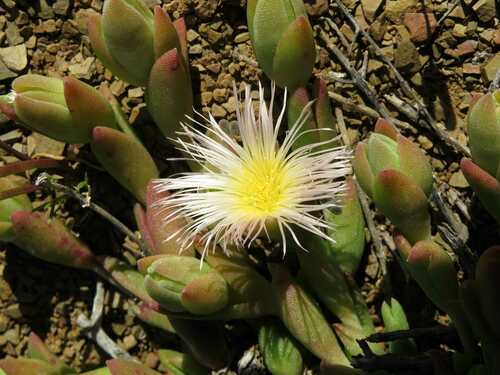
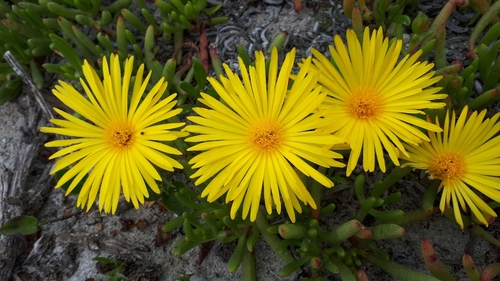
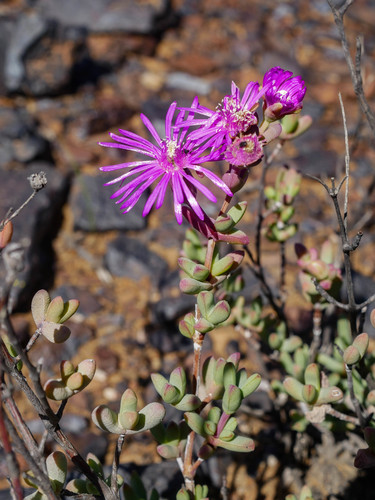
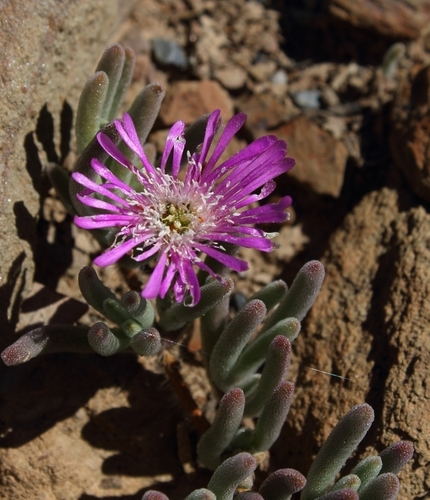
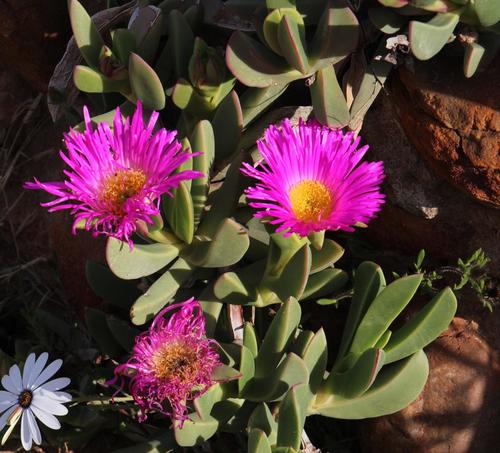
This Carpobrotus, commonly known as sour-fig, species bears the largest flowers of any species in the Mesembryanthemaceae family. Its flowers are most often bright pink, though white-flowered variants grow at the far northern edge of the species' distribution range. Flowers appear in spring. The receptacle is typically subclavate, with a base that narrows abruptly where it connects to the stalk. The top of the ovary is flat or slightly raised at its center. Ripe fruits of Carpobrotus quadrifidus are sweet and edible raw, and they are grazed by tortoises and other native southern African animals.
This is an extremely robust species, with leaves that are much larger than the leaves of other Carpobrotus species. The leaves are glaucous-grey, with a distinctively smooth, hard, firm texture and cartilaginous margins. They are erect, relatively straight (or only slightly shaped like a scimitar, that is, acinaciform), and have an isosceles triangle-shaped cross-section.
This species' natural habitat is the low-lying coastal strip along South Africa's west coast. It ranges from Melkbosstrand in Cape Town in the south, north along the coast through Saldanha Bay and Langebaan—where it is extremely common—to the coast around Lambert's Bay. Further scattered, isolated populations occur even further north in the Northern Cape province. In Cape Town, south of the species' natural core distribution, it intergrades with the related species Carpobrotus acinaciformis.