About Carphophis amoenus (Say, 1825)
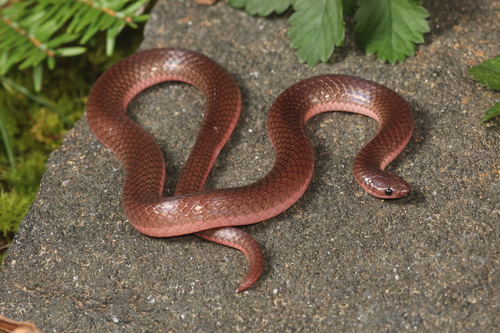
Carphophis amoenus, commonly called the worm snake, is a small snake species. Adults measure 19–28 cm (7.5–11.0 in) in total length, with a maximum recorded length of 34 cm (13 in). It is brown or tan to dark brown on its dorsal side, and bright pink ventrally; the pink ventral pigmentation extends up onto the first one or two dorsal scale rows. Its dorsal scales are smooth, arranged in 13 rows. It has five upper labials and one postocular scale, a small pointed conical head that is no wider than its neck, and small black eyes. Coloration across the body is entirely unpatterned. The tail is short relative to the body, and ends in an abrupt, spine-like scale. Females are longer than males, but have shorter tails. This species can be distinguished from similar-looking small unpatterned brownish snakes like earth snakes (genus Virginia) and red-bellied snakes (Storeria occipitomaculata) by several traits: those species have keeled body scales, and lack the spine-tipped tail. Other identifying traits for C. amoenus include smooth, pitless body scales usually arranged in 13 midbody rows, and a split anal plate. The western worm snake (Carphophis vermis), which is often confused with C. amoenus, was previously considered a subspecies of C. amoenus; it differs by having ventral pigmentation that extends up to the third body scale row, and a dark gray or gray-violet dorsal surface. The southeastern crowned snake (Tantilla coronata) can be distinguished by its 15 midbody scale rows, dark head, and dark neck collar. Two subspecies of Carphophis amoenus are currently recognized: Carphophis amoenus amoenus (eastern worm snake) and Carphophis amoenus helenae (midwestern worm snake). The geographic range of C. amoenus as a whole covers southern Connecticut, southwestern Massachusetts, southeastern New York, New Jersey, southeastern Pennsylvania, Delaware, Maryland, Virginia, eastern West Virginia, North Carolina, South Carolina, northern Georgia and Alabama, the northeastern part of Mississippi (only common in this region, and in the northern and eastern sections of the Short-Leaf Pine Belt), and the Appalachian Mountains of Kentucky and Tennessee. The subspecies C. a. amoenus specifically ranges from Rhode Island, southwestern Massachusetts, and southeastern New York south to South Carolina, northern Georgia, and central Alabama. C. a. amoenus has separate internasal and prefrontal scales, and no gular scales between its posterior chin shields. Each maxilla holds 9–12 small teeth. Its single hemipenis has a forked sulcus spermaticus and three large basal spines. Adult males have ridges on the body scales located dorsal to the anal plate. Young C. a. amoenus are always much darker than adult individuals; they change from dark gray to the adult brown color during their second year. The eastern worm snake (C. a. amoenus) is almost exclusively an earthworm predator, but is also known to consume other prey including slugs and small salamanders. Males travel much farther than females, and their diet consists primarily of earthworms, but may also include other soft-bodied invertebrates such as insect larvae. Due to human activities, C. a. amoenus is becoming rare in some areas; it is currently protected as threatened in Massachusetts and as a species of special concern in Rhode Island. Worm snakes are burrowing, fossorial animals that are seldom seen by people. Their annual activity period changes with latitude and elevation. On the coastal plain of South Carolina, individuals have been found active in every month except February. Farther north, worm snakes are active from March–April through October–November. Few individuals are active above ground during summer, but a second smaller period of above-ground activity occurs in fall. To avoid overheating or desiccation, worm snakes spend most of the year underground or inside rotting logs. They are most commonly found in forests with high leaf litter and dense canopy cover. They generally remain inactive during extreme temperatures, though most of their surface activity is positively correlated with very high temperatures. They burrow by working their small, pointed heads into cracks and crevices. Activity most often begins in late afternoon and early evenings, and rarely lasts longer than 12 hours. While C. amoenus amoenus does not move very far overall, individuals have been recorded traveling 45 m within a 24-hour period. Known predators of worm snakes include other snakes, thrushes, American robins, barn owls, and opossums. Threats to the species include road traffic mortality, flooding of lowlands and other natural disasters, human-caused habitat destruction, and occasional death from insecticide poisoning. When handled, worm snakes release a foul-smelling liquid from their vents, but they are completely harmless to humans and very rarely attempt to bite. They are very shy and mild-mannered; when handled, they typically twist, attempt to crawl between a handler’s fingers, probe the hand with their tail spine, and emit the strong-smelling liquid. Courtship and mating for C. amoenus most likely occurs in spring, as the two sexes are most often found together between late April and June. Developing eggs can be seen through the female’s translucent venter in late May and June. Oviposition takes place between early June and mid-July, specifically between 5 June and 15 July in northern Virginia. Clutches contain two to eight eggs. Eggs are smooth and elongated, measuring 16–25 mm (0.63–0.98 in) long by 7–8 mm (0.28–0.31 in) wide, and often one end of the egg is wider than the other. Hatching occurs in August or early September. Hatchlings are about 100 mm (3.9 in) in total length, and are darker than adults. Clutches of eggs are found in depressions under rocks, cavities in the rotting wood of logs and stumps, inside old sawdust piles, and rodent burrows are also likely used as nesting sites. In 75% of observed clutches, a female was found nearby or with the eggs.