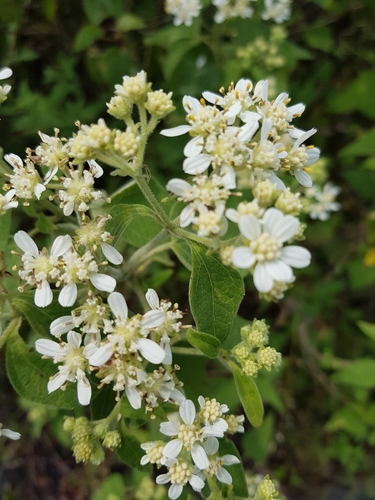
About Carphephorus subtropicanus DeLaney, N.Bissett & Weidenh.
Carphephorus odoratissimus, previously synonymized as Trilisa odoratissima, and commonly called vanillaleaf, is a species of North American flowering plant in the Asteraceae family. It is native to the southeastern United States, where it occurs in the states of Georgia, North Carolina, South Carolina, Alabama, Mississippi, Louisiana, and Florida.
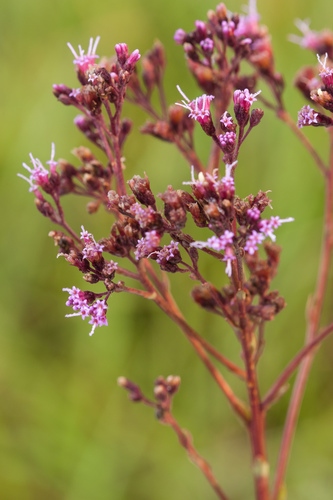
This plant is a largely glabrous herbaceous perennial that can reach up to 180 cm (6 feet) in height. It forms a flat-topped inflorescence holding many small purplish flower heads, which contain only disc florets with no ray florets.
Two varieties of this species are recognized: Carphephorus odoratissimus var. odoratissimus, found in Georgia, North Carolina, South Carolina, Alabama, Mississippi, Louisiana, and Florida; and Carphephorus odoratissimus var. subtropicanus Wunderlin & B.F.Hansen, native to Central and South Florida.
Carphephorus odoratissimus grows primarily on sandy and well-drained loamy soils. Its typical habitats include oak-pine woodlands on Ultisols, sand ridges within flatwoods, moist areas, burned upland longleaf pine-wiregrass communities, and pine-saw palmetto woodlands.
Carphephorus odoratissimus var. odoratissimus gets its common name vanillaleaf from the vanilla-like scent released by its foliage. This scent comes from a 1.6% coumarin content, which is its main aromatic compound. Because of this fragrance, this variety has a history of use in cosmetics, herbal medicine, and as an additive to smoking tobacco. Its leaves can be used to prepare a tonic to treat malaria.