About Carpha alpina R.Br.
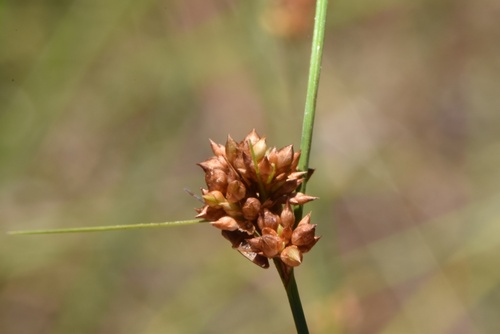
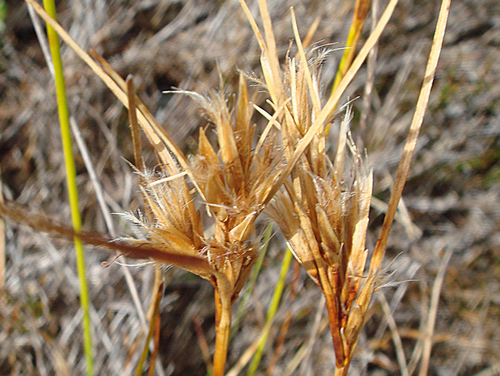
Carpha alpina (scientific name: Carpha alpina R.Br.) is a short, rhizomatous, tufted perennial sedge. It produces rigid, striated, glabrous culms that reach 2 to 10 cm tall and 0.7 to 1.5 mm wide. It has numerous stiff, flattened leaf blades that are grey-green or red-green, with yellow-brown sheaths, and measure 0.5 to 2 mm wide. Its inflorescence consists of 1 to 3 loose clusters 1 to 10 cm long, with single or paired bracts that are slightly longer than the inflorescence. Spikelets are 8 to 10 mm long and arranged in clusters of 2 to 10. The brown, acute, keeled glumes are divided into upper and lower sections. The lowest 2 or 3 glumes are empty and half the size of the upper glumes. Upper glumes are larger, measuring 8 to 9 mm long, with a bristle-like glume positioned above them; these bristles are 7 to 10 mm long and coloured red or brown. The fruit is a narrow-ellipsoid brown nut, 2.5 to 3 mm long. This nut has a short stipe and is topped by a rigid, 3 to 5 mm long style-base that is either smooth or slightly hairy. Carpha alpina is widespread across the montane and subalpine areas of Tasmania, and the mountainous regions of Victoria and New South Wales, Australia. It also occurs in mountainous areas of New Zealand and Papua New Guinea. It grows in habitats ranging from coastal to alpine bogs, mires, and wet alpine and subalpine areas, where it can colonize sites disturbed by environmental factors.