About Carnegiea gigantea (Engelm.) Britton & Rose
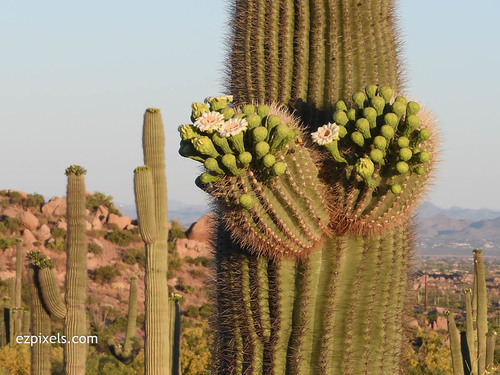
Carnegiea gigantea, commonly known as the saguaro, is a columnar cactus that develops prominent branches usually called arms. A single saguaro can grow over 50 arms, and one recorded specimen has 78 arms. Mature saguaros reach 3–16 m (10–52 ft) in height, and can grow up to 75 cm (30 in) in diameter. This species grows very slowly, typically lives 150 to 200 years, and is the largest cactus native to the United States. Its growth rate is strongly tied to local precipitation: saguaros in drier western Arizona grow only half as fast as populations in and around Tucson, Arizona. Saguaros grow from seed, and may reach only 6.4 mm (1⁄4 in) in height after two years. Cuttings taken from saguaros rarely root; even when they do root, they do not go through a juvenile growth phase, resulting in a different overall appearance. Since 2014, the largest known living saguaro in the United States has been listed in the National Register of Champion Trees. This specimen grows in Maricopa County, Arizona, measuring 13.8 m (45 ft 3 in) tall with a girth of 3.1 m (10 ft 2 in); it is estimated to be 200 years old and survived damage from the 2005 Cave Creek Complex Fire. The tallest saguaro ever measured was an armless specimen found near Cave Creek, Arizona, which stood 78 ft (23.8 m) tall before it was knocked over by a windstorm in 1986. Saguaros are stem succulents that store large volumes of water; when fully hydrated after abundant rain, a saguaro weighs between 1,500 and 2,200 kg (3,200 and 4,800 lb). This species has an extensive root network that can extend up to 30 m (100 ft) across, plus a long taproot that reaches up to 1 m (3 ft 3 in) deep. Saguaros may take 20 to 50 years to reach a height of just 1 m (3 ft 3 in). Individual stomatal guard cells and medulla cells of the saguaro can live and function for up to 150 years, which may be the longest lifespan of any non-nerve cell; only nerve cells in some tortoises are thought to live longer. Like other cacti, saguaros use crassulacean acid metabolism for photosynthesis, which gives very high water-use efficiency. This adaptation means saguaros only transpire at night, minimizing water loss during hot daytime conditions. An armless saguaro is called a "spear". A small number of saguaros develop a rare abnormal growth form called cristate, or crested, saguaro. This formation is thought to occur in roughly 1 out of every 10,000 saguaros, and 2,743 crested saguaros have been documented to date. Crested growth is caused by fasciation, which creates a seam of abnormal growth along the top of the cactus or the top of one of its arms. The saguaro is endemic to the Sonoran Desert. It is found primarily in western Sonora, Mexico, and western Arizona, United States. Only 30 wild saguaros are known to occur in southeastern California. Elevation acts as a limiting factor for the species' range, because saguaros are sensitive to extended periods of frost or cold temperatures. No confirmed wild saguaro specimens have been found in Nevada, New Mexico, Texas, Colorado, Utah, or the high deserts of northern Arizona. The northern edge of the species' range is at the Hualapai Mountains in Arizona, and the saguaro is the northernmost naturally occurring columnar cactus in the Americas. The saguaro's overall distribution is strongly correlated with low minimum temperature stress and low minimum vapor pressure deficit. The saguaro is a keystone species, and provides food, shelter, and protection to hundreds of other species. Every life stage of the saguaro, from seedling through after the plant's death, supports a large number of other organisms. As a food source for wildlife, the saguaro produces abundant pollen, nectar, and fruits. White-winged doves and ants eat the saguaro's fruits, so few seeds escape to germinate. White-winged doves are also important pollinators of saguaro blooms, and visit these flowers more often than any other bird species. For desert populations of white-winged doves, 60% or more of their diet comes from saguaros, and the doves' breeding cycle lines up with the saguaro's blooming period. Arizona designated the saguaro blossom as its territorial flower on March 13, 1901, and it became the official state flower of Arizona on March 16, 1931. The saguaro is often used as an emblem in commercials and logos meant to convey a sense of the American Southwest. Notably, no naturally occurring saguaros grow within 400 kilometers (250 miles) of El Paso, Texas, but a saguaro silhouette appears on the label of Old El Paso brand food products. While this geographic mismatch has become less common in recent years, mid-20th century Western films frequently depicted saguaros growing in Monument Valley (north of their native range in Arizona), as well as in New Mexico, Utah, and Texas, outside the species' natural range. America West Airlines, which was based in Phoenix, Arizona, used the radio call sign "CACTUS" for flight communication, as a tribute to the saguaro cacti native to the Phoenix area. After America West merged with U.S. Airways in 2007, U.S. Airways continued to use this call sign.