About Carlina acaulis L.
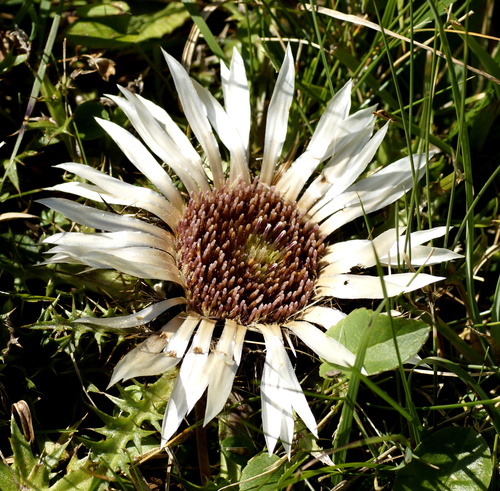
Carlina acaulis L., commonly called stemless carline thistle, dwarf carline thistle, or silver thistle, is a perennial dicotyledonous flowering plant in the daisy family Asteraceae, native to the alpine regions of central and southern Europe. Both its specific epithet acaulis (Neo-Latin for "without a stem", derived from Latin caulis meaning stem or stalk) and its common names refer to how its flower head sits directly on top of a basal leaf rosette. This species is named after Charlemagne, who searched for a plague treatment. According to the legend, Charlemagne dreamed that an angel told him to shoot an arrow into the sky, and the plant the arrow landed on would relieve the plague. The arrow hit Carlina acaulis; after its roots were distributed to the population, the plague diminished. The plant's spiny, pinnatilobate leaves grow in a basal rosette that is roughly 20 cm in diameter. It produces large flower heads up to 10 cm across, made up of silvery-white ray florets surrounding a central disc. The disc florets are tubular and yellow-brown in color. To protect its pollen, the flower head closes during wet weather; folklore holds that this closing predicts upcoming rain. Flowering occurs between August and September. It prefers chalky soils and dry pastures, growing from valleys up to an altitude of 2,800 m. There are two recognized subspecies: Carlina acaulis subsp. acaulis, which has sessile inflorescences, and Carlina acaulis subsp. simplex, which has inflorescences borne on a short stem. The rhizome of this plant contains multiple essential oils, most notably the antibacterial compound carlina oxide. Its root was formerly used in herbal medicine as a diuretic and a remedy for colds. When young, the flowerhead bud can be cooked and eaten in a similar way to the globe artichoke, which gave it the nickname "hunter's bread". It is sometimes cultivated as a rock garden plant, or dried and hung as indoor decoration. In traditional Basque culture, it was used as a symbol of good fortune, fixed to the front door of homes, and said to be a gift from the goddess Mari.