About Carlia jarnoldae Covacevich & Ingram, 1975
Size
This species, scientifically named Carlia jarnoldae, can reach a snout-to-vent length of almost 5 centimeters, or 2.0 inches.
Dorsal Scale Structure
Its dorsal scales are tricarinate, meaning each scale has three keels.
Dorsal Pattern
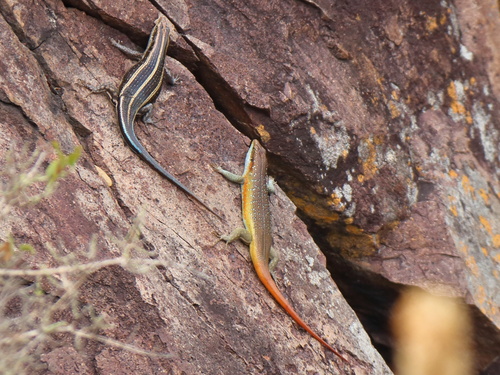
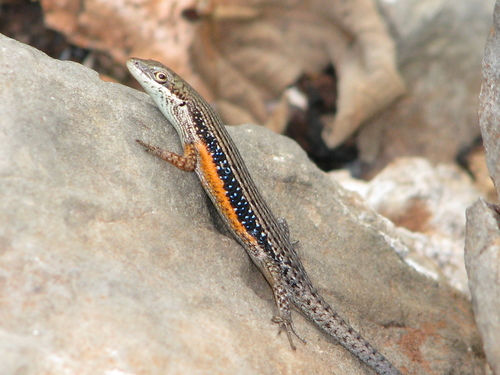
Along its dorsal surface, there are 5 to 7 black lines.
Upper Flank Pattern
The upper portions of its flanks are black, marked with small light blue spots.
Lower Flank and Leg Coloration
The lower flanks and front legs are bright orange.
Lateral Stripe Morphology
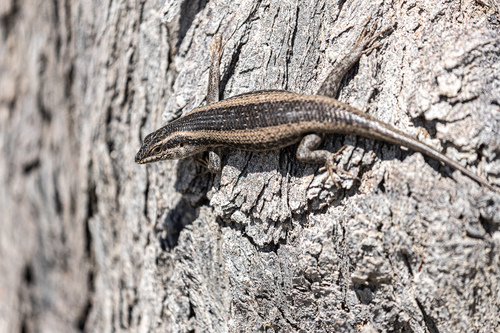
A white lateral stripe starts on the upper labials, runs through the ear opening, and continues along the neck.
Natural Habitat
The preferred natural habitat of Carlia jarnoldae is the rocky regions of forests and savannas.
Reproduction Mode
This species reproduces by being oviparous, meaning it lays eggs.