About Carissa macrocarpa (Eckl.) A.DC.
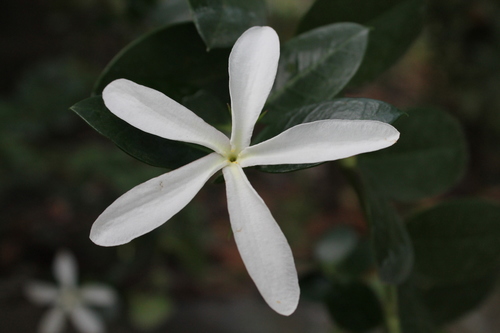
Carissa macrocarpa (Eckl.) A.DC. is a shrub native to tropical and southern Africa, and is commonly called Natal plum, amathungulu, big num-num, or large num-num. This species tolerates salt-laden winds very well, which makes it an excellent choice for planting in coastal areas. It is naturally found in the coastal bush of the Eastern Cape and Natal in South Africa. It is a spiny, evergreen, latex-containing shrub, similar to other species in the Carissa genus. It produces shiny deep green leaves and snowy white flowers; the scent of these flowers becomes stronger at night. Its flowering periods can last for multiple months at a time. Plump, round, ornamental crimson fruits grow during summer and autumn, appearing at the same time as the blooms. In moderate coastal climates, this plant can produce fruits year-round. The fruit can be eaten raw, or processed into pies, jams, jellies, and sauces. Some people claim that all parts of the plant except the fruit are poisonous, but this claim is considered a myth, likely stemming from the plant's resemblance to other plants that have milky sap. However, the College of Agricultural and Environmental Sciences at the University of California, Davis classifies this plant as mildly toxic. This species is listed as entry number 640.3 on the South African National tree list. It is a traditional food plant in Africa, and its little-known fruit has potential to improve nutrition, boost food security, support rural development, and sustain sustainable landcare. Carissa macrocarpa grows primarily in coastal areas of South Africa, where it can be found on sand dunes and along the edges of coastal forests, ranging from the Eastern Cape northwards to Natal and Mozambique. The species also grows naturally in Zambia, Zimbabwe, and further north in the Democratic Republic of the Congo and Kenya. Today, this plant grows commonly in southern Florida, is cultivated in southern California, and is widely used as an ornamental plant in Hawaii, Central America, and the Caribbean. In the species' native range, its white bisexual flowers are pollinated by night-flying insects. Outside of its native region, failure to produce fruit has been linked to inadequate pollination. Hand pollination can be done successfully, and poor pollination may be avoided in the future by cultivating varieties with floral structures that are highly favorable for self-fertilization.