About Carica papaya L.
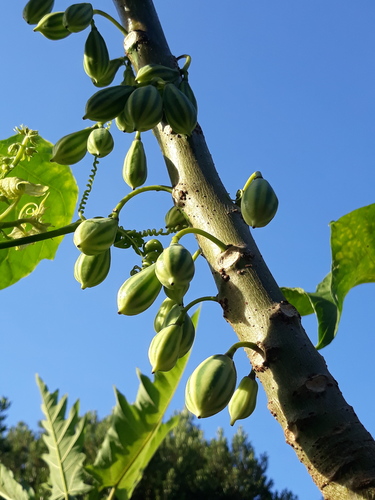
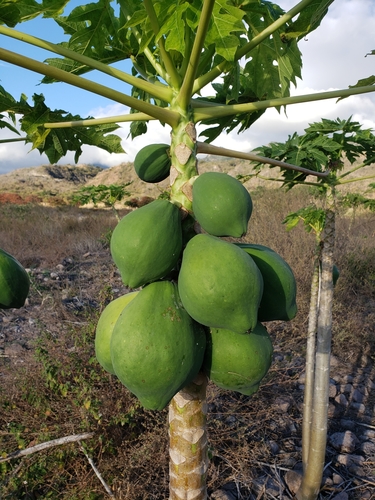
Carica papaya L., commonly known as papaya, is a large herbaceous plant that usually grows a single trunk reaching 5 to 10 meters (16 to 33 feet) tall. Its spirally arranged leaves grow only at the top of the trunk, and the lower trunk has prominent scars from where leaves and fruit previously grew. Papaya leaves are large, 50–70 centimeters (20–28 inches) in diameter, deeply palmately lobed, and typically have seven lobes. All parts of the papaya plant contain latex in articulated laticifers.
Papaya is native to tropical America, originating from southern Mexico and Central America. It is also considered native to southern Florida, where it was introduced by predecessors of the Calusa people no later than 300 AD. Spaniards brought papaya to the Old World in the 16th century, and today papaya cultivation is nearly pantropical, occurring across Hawaii, Central Africa, India, and Australia. Wild papaya populations are generally restricted to naturally disturbed tropical forests. In the Florida Everglades, papaya grows abundantly on hammocks after major hurricanes, but is uncommon at other times. In the rainforests of southern Mexico, papaya grows and reproduces quickly in canopy gaps, but dies off in mature closed-canopy forests.
Unripe papaya releases latex fluid, which may cause irritation and allergic reactions in some people. The papain enzyme in papaya acts as an allergen for sensitive individuals, so meat tenderized with papain may trigger an allergic reaction in these people.
Historical records from 18th-century travelers and botanists indicate that papaya seeds were carried from the Caribbean to Malacca, then to India. From Malacca or the Philippines, papaya spread across Asia and into the South Pacific. Francisco de Paula Marín, a Spanish explorer and horticulturist, is often credited with introducing papaya to Hawaii from the Marquesas Islands in the early 1800s. Since that time, papaya cultivation has spread to all tropical countries and many subtropical regions worldwide. Today, papaya is grown widely across the globe, due to its climate adaptability and popularity as a tropical fruit.
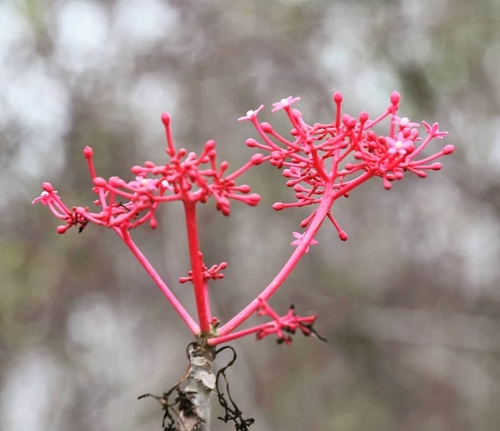
Papaya plants have three sexual forms: male, female, and hermaphrodite. Male plants only produce pollen and never bear fruit. Female plants produce small, inedible fruits unless pollinated. Hermaphrodite plants can self-pollinate, because their flowers contain both male stamens and female ovaries. Almost all commercial papaya orchards grow only hermaphrodite plants. Originally from southern Mexico (particularly Chiapas and Veracruz), Central America, northern South America, and southern Florida, papaya is now cultivated in most tropical countries. Under cultivation, it grows rapidly and begins fruiting within three years. However, it is highly sensitive to frost, which restricts its production to tropical climates. Temperatures below −2 °C (29 °F) are severely harmful, and often fatal, to papaya. In Florida, California, and Texas, papaya growth is generally limited to the southern parts of these states. It prefers sandy, well-drained soil, as standing water can kill the plant within 24 hours.
Ripe papaya fruit is most commonly eaten raw, with the skin and seeds removed. Its black seeds are edible and have a sharp, spicy flavor. Unripe green papaya is usually cooked before eating, due to its high latex content. Both green papaya fruit and its latex are rich in papain, a cysteine protease used to tenderize meat and other proteins, a practice that continues today among indigenous Americans, people from the Caribbean, the Pacific Islands, and the Philippines. Papain is also an ingredient in some powdered meat tenderizers. Papaya cannot be used in gelatin-set foods such as jelly or aspic, because papain's enzymatic properties stop gelatin from setting. In traditional medicine, papaya leaves have been believed to treat malaria, act as an abortifacient, act as a purgative, or be smoked to relieve asthma.