About Carex secta Boott
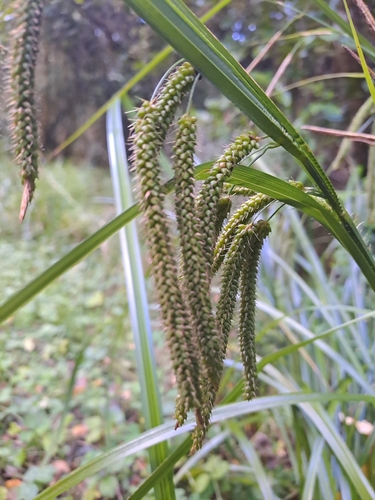
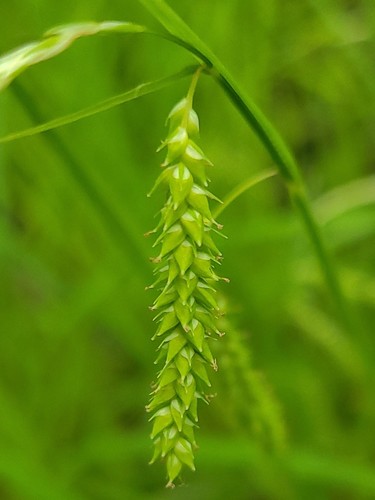
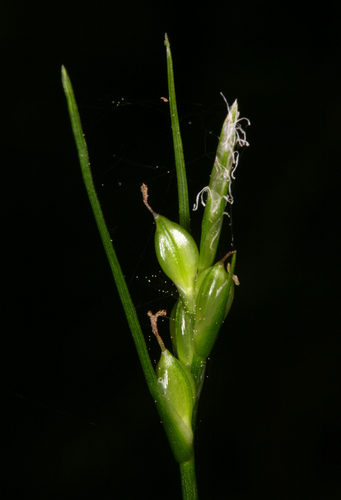
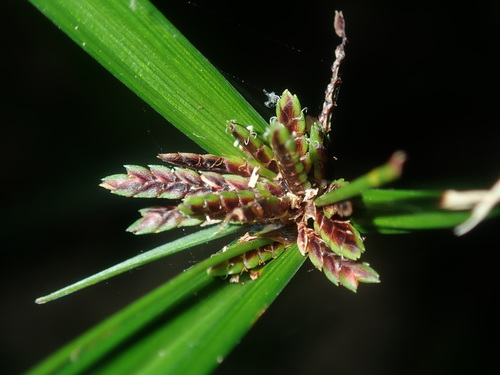
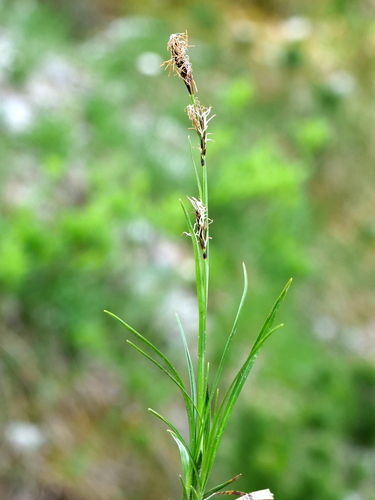
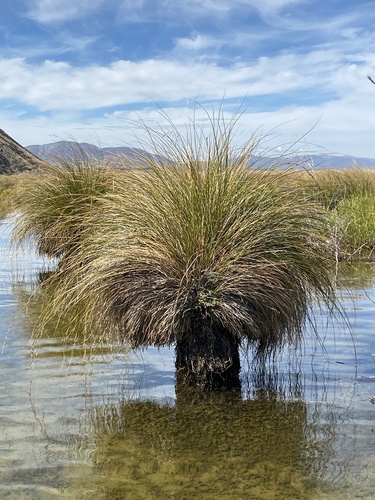
The scientific name of this species is Carex secta Boott. The genus name Carex comes from the Latin word for sedge, and the species epithet secta means cut or divided, referring to its divided flower head. Sedges look similar to grasses and rushes but are distinct botanically. Carex secta is a perennial monocotyledon that can grow up to 3 meters tall. The base of the plant forms a clumpy, trunk-like structure that reaches up to 1 meter in height and 50 cm in diameter. This structure is composed of matted rhizomes, old culms (old aerial stems), older rhizomes, and roots, and these clumps are usually pale to dark brown in color. Key identifying features include triangular, very narrow leaves that are 1.5–7 mm wide. Leaves have a simple margin, are rough to the touch along the edges, are usually longer than or equal in length to the flowers, and range in color from pale to light green to yellow green. Leaves are channeled, meaning they have a groove running along their length, and have a very rough, scabrid surface. Flower stems, like leaves, are drooping, triangular in shape, and rough to the touch. These drooping fruit-holding culms are 0.25–1 meter tall. Flowers grow on a loosely branching panicle that can be up to 45 centimeters long. The panicle holds numerous pale brown spikes that are mostly grouped at the tips of slender branchlets. The small spikelets at the ends of branchlets contain both male and female flowers: male flowers sit closer to the tip of each spike, while female flowers sit lower on the panicle and have two stigmas. The fruit is a triangular or lens-shaped nut with a short beak, measuring 2.5–3 mm long and 1.5 mm wide. The utricle, a sac surrounding the fruit, is 2–5 mm long, dark brown, has minor winged margins, and also contains two stigmas. Up to 2000 varieties of Carex occur worldwide in cold and temperate climates, as well as on tropical mountain ranges. Within New Zealand, there are 100 total Carex species, 79 of which are endemic, and Carex secta is one of these endemic species. Carex secta tolerates a wide range of growing conditions, and can be found throughout New Zealand on the North Island, South Island, and Stewart Island, growing from coastal to mountainous areas usually up to 400 meters above sea level. It also occurs on mainland Chatham Island, where it is relatively rare. In New Zealand, sedges are very common swamp plants, and the Carex genus includes the largest sedges. Carex secta thrives in open water environments including swamps, rivers, lakes, ponds, and streams. Its growth is not inhibited when its roots are saturated, and it can tolerate year-round waterlogging. It prefers water depths between 10 and 30 cm, which provide optimal growing conditions. When naturally dispersed seeds germinate in water depths greater than 30 cm, the resulting plants have increased shoot height but decreased shoot density. Because Carex secta can flourish with permanently saturated roots, it is frequently used in riparian planting margins across New Zealand. While it typically grows well in wetlands, it can also grow successfully in drier environments, and grows best in moist to wet soils. These soils, most common in wetlands, are generally organic or organic peaty soils. Wetlands on the West Coast of New Zealand with a pH between 5.7 and 6.0 provide ideal growth conditions for Carex secta; in these areas, it can grow in much deeper water up to 0.6 meters deep, and forms colonies alongside Carex coriacea. Above its typical altitude range, Carex secta has been found at the head of the Gorge River in South Westland, around 700 meters above sea level, where it grows in much shallower peat soils. It also occurs in the Copland Valley, South Westland, growing at 450 meters above sea level in swamps near geothermal activity. Carex secta flowers from late September to early December, with slight variation in timing depending on environmental conditions. It typically fruits between October and March, with fruits ripening in the later months before dispersal. Seeds are dispersed via three methods: granivory (dispersal through consumption by seed predators), anemochory (wind dispersal), and hydrochory (water dispersal). Seed germination is temperature dependent: it takes 3–4 weeks in the warmer conditions of summer, and is slower in colder conditions. Seeds remain viable in the soil for a long time, so when wetland vegetation is cleared and light reaches the ground, large numbers of seeds will germinate. No specific studies have tested the seed longevity of Carex secta, but studies of Carex genus seed banks indicate some Carex species can have viable seeds for up to 130 years. Historically, the leaves of Carex secta were used as thatch for building roofs. Māori have a proverb referring to Carex secta: "He pūreirei whakamatuatanga. A faithful fatherly tuft of rushes." This proverb describes the species as a trustworthy, reliable place to stop and rest while crossing swampy land. Today, Carex secta is also used as an ornamental plant, and is often included in home gardens and landscape architecture projects.