About Carex rosea Willd.
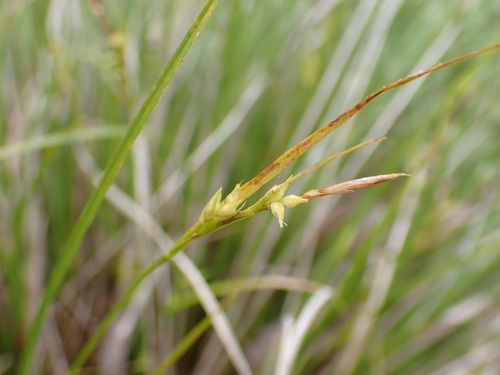
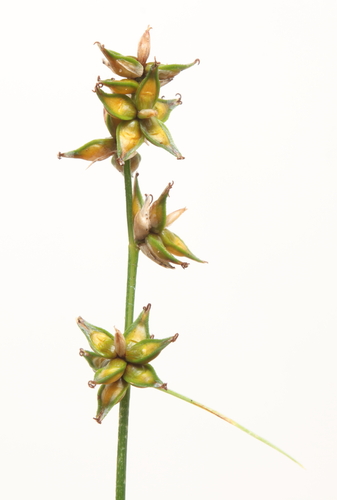
Carex rosea Willd. flowers in spring and has evergreen leaves. Its styles, the stalks that connect the stigma to the ovary, are distinctly curled, which helps distinguish this species from other plants. Stigmas of this species are between 0.07 and 0.10 mm thick. Leaves are approximately 1/8 mm wide overall, while stem leaf blades have a width range of 1.8 to 2.6 mm. The lowest bract either lacks a sheath, or has a very short sheath that measures no more than 4 mm in length. The lowest spike does not grow on a peduncle, the stalk that supports an inflorescence holding multiple flowers. The uppermost spike contains both carpels and stamens; carpels are located below the stamens, or mixed in among them. The membrane that encloses the flower is hairless, and ranges from 2.6 to 4.2 mm in length. Leaf sheaths have no pink, red, or purple tinting. Leaf blades can be either smooth and hairless, or rough and sandpapery. All leaves grow from the base of the plant. Its one-seeded fruit, which usually measures 1.6 to 2.2 mm, has no folds or dimples. The plant's spikelets are widely spread rather than clustered, and culms hold between 4 and 8 spikelets. Spikelets appear green, due to the presence of 7 to 14 spreading perigynia. C. rosea is distributed from Nova Scotia and southern Quebec west to Minnesota and eastern Nebraska, and south to Georgia, Tennessee, and Arkansas. Its habitat is dry-to-moist woodlands. It can adapt to a variety of soil types, and can also grow in rich ravines and wood edges. Carex rosea completes its life cycle in a little over two years. While the genus Carex has historically been considered nonmycorrhizal, recent evidence suggests that mycotrophy may be more widespread among sedges than previously understood.