About Carex riparia Curtis
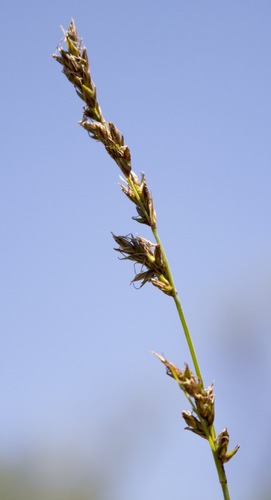
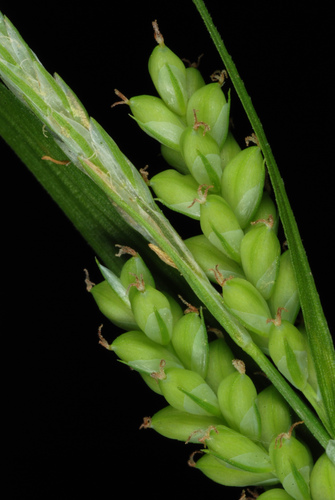
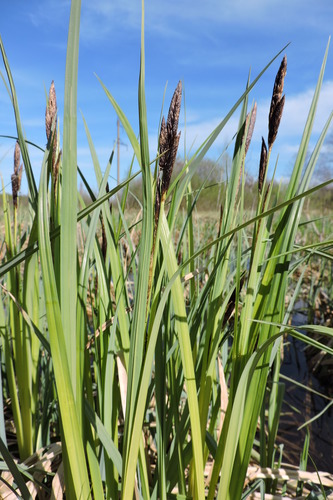
Carex riparia Curtis was first formally described by William Curtis in his 1783 publication Flora Londinensis. This species is often easily confused with Carex acutiformis, lesser pond sedge, but can be distinguished by its greater number of male spikes, which grow clustered closely together at the top of the culm. The leaves of C. riparia are glaucous, up to 160 centimetres (63 in) long, and 6–20 millimetres (0.24–0.79 in) wide, tapering at the tip to a trigonous point. Its stems are 60–130 cm (24–51 in) tall, rough in texture, and sharply triangular in cross-section, making C. riparia the largest Carex species native to Britain. The stems produce 1 to 5 female spikes that are nearly cylindrical and generally overlap one another, along with 3 to 6 male spikes arranged more densely together. Each female spike measures 3–10 cm (1.2–3.9 in) long, and often has a few male flowers at its tip; male spikes are 2–6 cm (0.8–2.4 in) long. The fruits of C. riparia are utricles 5–8 mm (0.2–0.3 in) long, with an inflated ovoid shape. They taper to a clear, bifid beak that holds three stigmas. C. riparia is known to hybridize with a number of other sedge species: it hybridizes with Carex acutiformis to form Carex × sooi, with C. lasiocarpa to form C. × evoluta, with C. rostrata to form C. × beckmanniana, and with C. vesicaria to form C. × csomadensis; it also hybridizes with C. elata and C. flacca. In terms of distribution and habitat, C. riparia has a broad range across Europe, Western Asia, and Central Asia, with isolated populations recorded in North Africa. It can form large dense stands along slow-flowing rivers, canals, lake edges, and in wet woodland. It may act as the dominant species in swamps, especially in locations that have standing water during the spring, and also grows in tall-herb fens alongside Carex acutiformis, Carex acuta, and other similar species.