About Carex pumila Thunb.
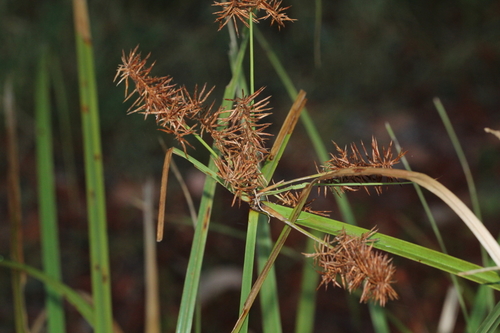
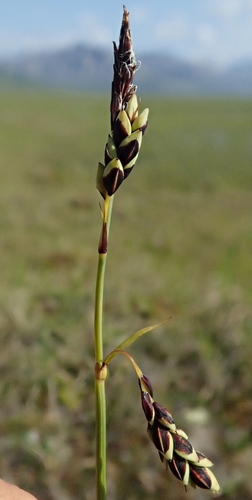
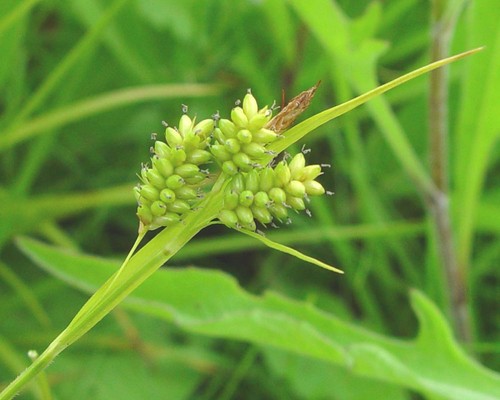
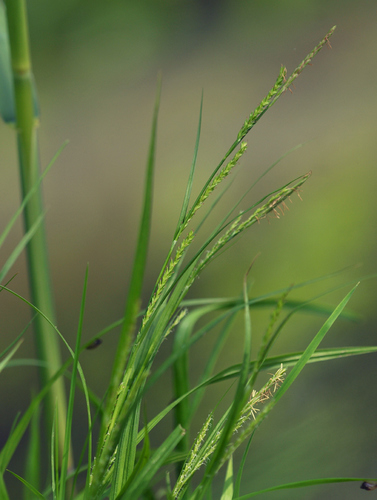
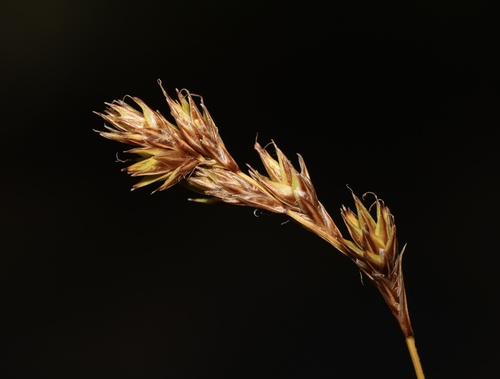
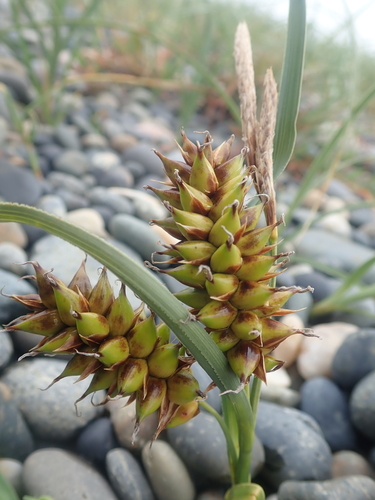
Scientific name: Carex pumila Thunb. This is a monoecious, rhizomatous perennial grass-like sedge that grows in a tufted habit, and usually reaches 0.4 metres (1.3 ft) in height. It blooms in summer; in Australia, this typically occurs between November and February, and it produces brown flowers. Its foliage is deep blue-green, forming coarse tufts that grow from a long creeping rhizome with a diameter of approximately 2 millimetres (0.08 in). The culms are usually buried in sand, and measure 5 to 30 centimetres (2.0 to 11.8 in) in length. Culms are terete, smooth, and cream or light green in colour, but are almost completely enclosed by light cream brown to red-brown sheaths. Leaves are longer than the culms, growing up to 40 cm (15.7 in) in length and about 2 mm (0.08 in) in width. Leaves are channelled, rigid, curved, and taper to a fine point at the end. Its seeds are oval-shaped nuts, 2 to 3 mm (0.08 to 0.12 in) in length. This species has a wide distribution, and can be found in Australia, New Zealand, Lord Howe Island, Chile, China, Japan and Korea. It grows mostly along the coast in dune areas, but is occasionally found around the sandy margins of coastal rivers and estuaries. It also sometimes grows as an urban lawn weed, mostly in coastal settlements. In Australia, it occurs in coastal areas across much of temperate Australia, ranging from Queensland to Western Australia, and including Tasmania. In Western Australia, it grows on sand dunes in the Peel and South West regions, in sandy soils.