About Carex pilulifera L.
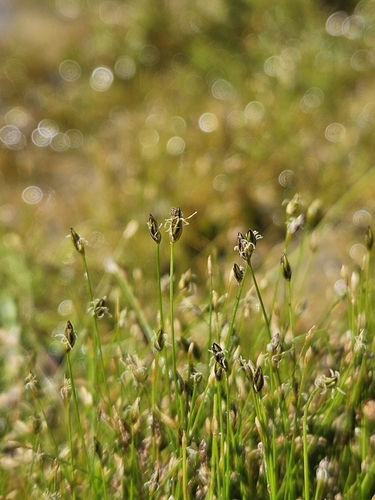
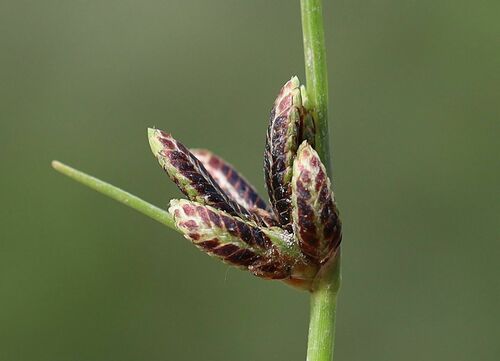
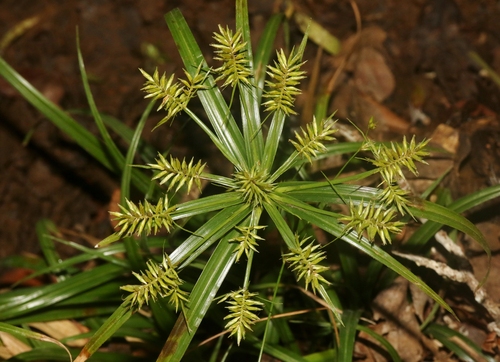
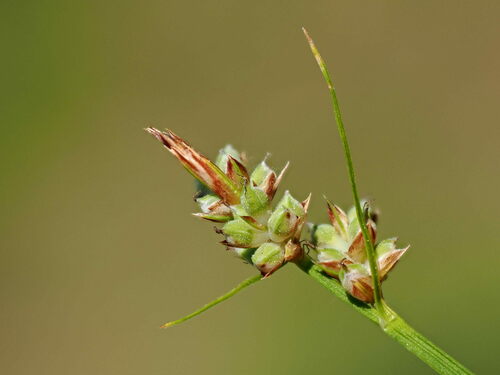
Carex pilulifera L., also known as pill sedge, has culms that reach 8–30 centimetres (3–12 in) in length and are often distinctly curved. Its leaves measure 5–20 cm (2–8 in) long and 1.5–2.0 millimetres (0.06–0.08 in) wide, and they are fairly flat. This species has very short rhizomes, which gives it a caespitose, or densely tufted, growth form. The tussock expands outward by producing new annual side-shoots each year. The inflorescence is made up of one single terminal staminate (male) spike, plus 2–4 lateral pistillate (female) spikes. All spikes are clustered together, and the entire inflorescence is 1–4 cm (0.4–1.6 in) long. Female spikes are 4–8 mm (0.16–0.31 in) long, shaped ovoid or nearly spherical, and hold between 5 and 15 flowers each. Each female spike attaches directly to the stem, and is subtended by a bract that does not form a sheath. The male spike is 8–15 mm (0.3–0.6 in) long and noticeably narrower than the female spikes. This species has a broad distribution across Europe, ranging from Macaronesia (the Azores and Madeira) and the northern Balkan Peninsula north to Scandinavia and northern European Russia. It grows on acidic substrates, in habitats including heathland, grassland, and woodland, and it most commonly occurs in soils with a pH between 4.5 and 6.0. As C. pilulifera seeds ripen, its culms bend until they may eventually touch the ground. Its seeds are dispersed by ants through a process called myrmecochory, most commonly by the ant species Myrmica ruginodis. The seeds are also eaten by other insects, including the ground beetle Harpalus fuliginosus.