About Carex pauciflora Lightf.
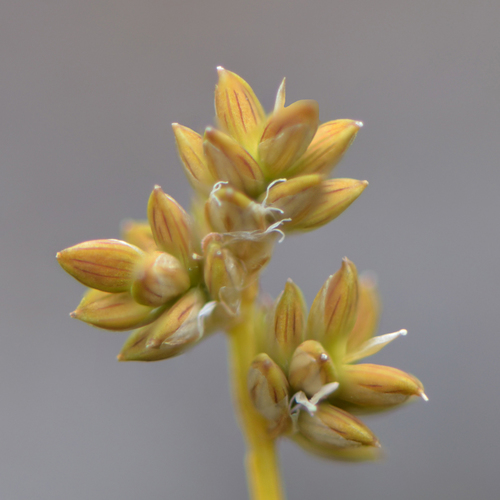
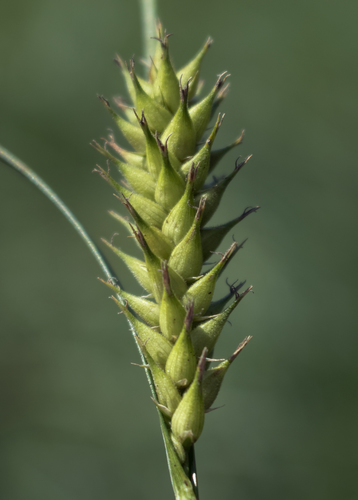
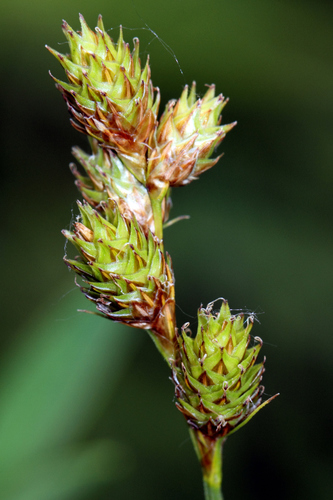
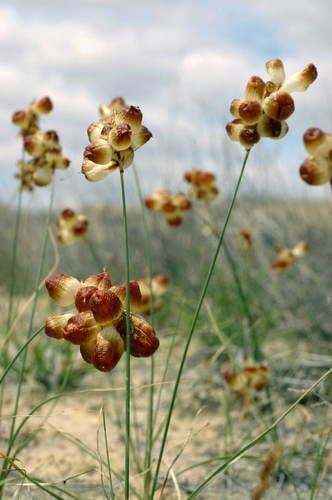
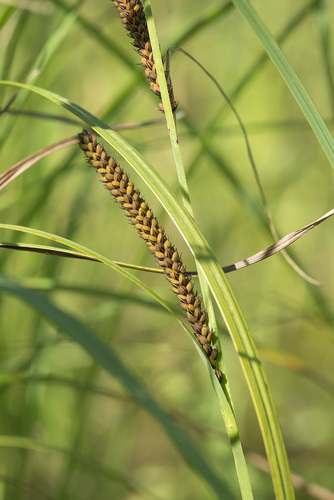
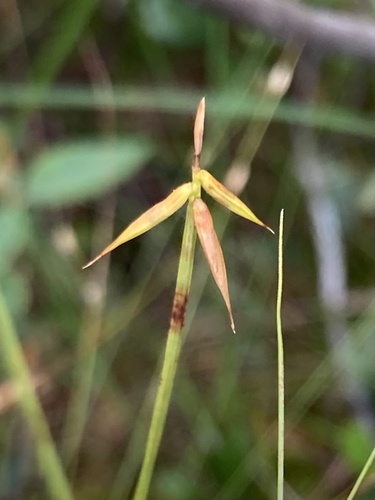
Carex pauciflora Lightf. reaches a maximum height of 60 centimetres (24 inches), and most commonly grows between 10 and 40 centimetres (3.9–15.7 inches) tall. It is a rhizomatous perennial sedge, with culms that grow either singly or in loose, diffuse clusters. A survey of Estonian populations found a mean rhizome length of 4.1 centimetres (1.6 inches), though rhizomes as long as 35 centimetres (14 inches) have been recorded. Each culm produces no more than three leaf blades; blades can grow up to 13 centimetres (5.1 inches) long and 1.6 millimetres (0.063 inches) wide. All parts of the plant are completely hairless. Individual flowers hold only male or only female reproductive structures, but the whole plants are monoecious, meaning they produce both flower types. Each culm only bears one spike, with female flowers positioned below male flowers on that spike. In unfavorable growing habitats, female flowers may fail to develop fully. Seeds of Carex pauciflora are dispersed through a mechanical mechanism. When the perigynium touches an object, the tissue at its base compresses. When pressure releases, this tissue acts as a spring and launches the perigynium outward. This species has a circumboreal distribution, found across cool temperate and subarctic regions of the Northern Hemisphere. It grows in bogs and other wet habitats with acidic soil. In the U.S. state of Washington, it occurs at elevations from 75 to 1,390 metres (246–4,560 feet), and it is classified as S2 (imperiled) there by NatureServe. Globally, the IUCN Red List classifies it as a species of least concern. It is present in every Canadian province and territory except Nunavut; it was only first recorded in the Northwest Territory in 2013, at a site near Fort Simpson. In Ukraine, it grows in bogs and fens in the Carpathians, and in Ovruch Raion of Zhytomyr Oblast near the Belarusian border. Some populations in North America are threatened by recreational activity. Populations in Estonia have declined due to development that destroys their wetland habitats, though the species has experienced less severe impact than many other sedge species. Populations in the Ukrainian Carpathians are threatened by climate change, which is drying out the bogs the species inhabits and allowing shrubs to invade these habitats. Fens that the sedge also occupies in this region are being invaded by trees and shrubs including Pinus mugo, Alnus alnobetula, Salix silesiaca, and Picea abies. Manual removal of more competitive non-wetland plants has been proposed as a conservation measure for this species.