About Carex molesta Mack.
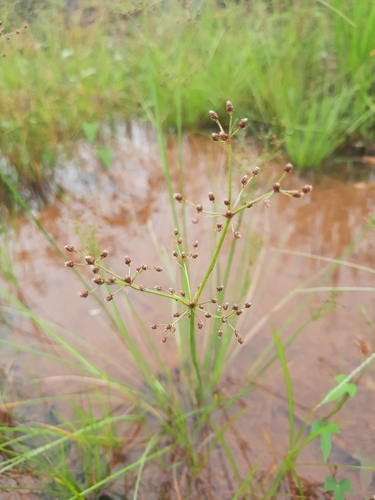
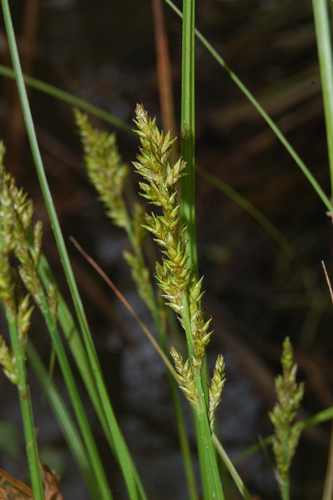
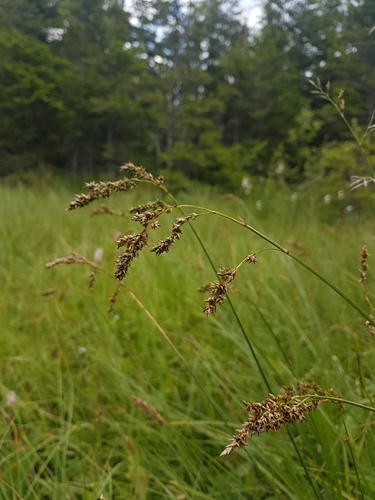
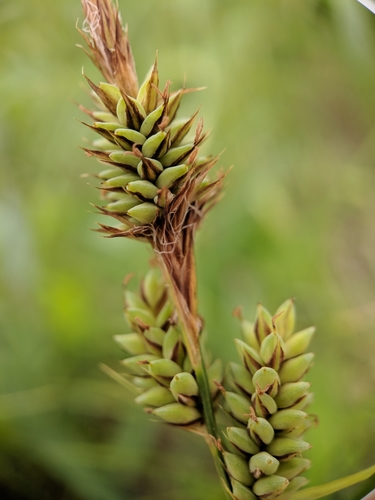
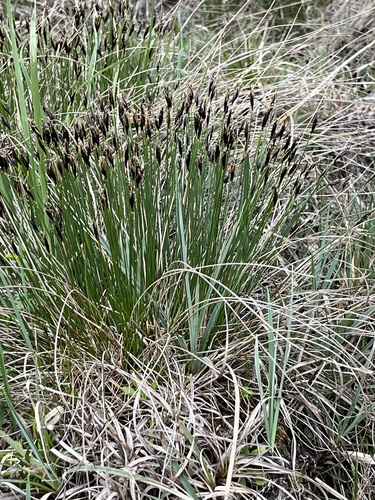
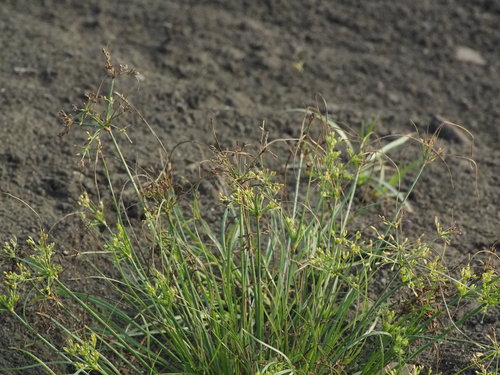
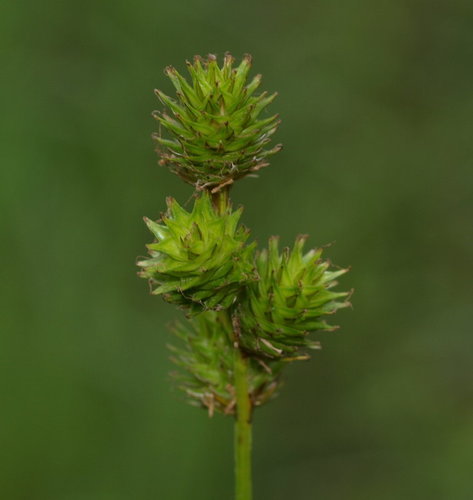
This sedge species forms clumps of stems that grow up to roughly 1 meter tall. It produces 3 to 7 alternate narrow leaves on the lower third of the stem; these leaves measure up to about 35 centimeters (14 inches) long, are 1.5 to 3.8 millimeters wide, and are shorter than the stems. The leaf edges are rough, particularly near the tips. Leaf sheaths wrap tightly around the stem, are mostly green near the tip, and the plant's stem bases are wrapped in an additional brown sheath. The ligule is either as wide as it is long, or wider than it is long. Old leaves often remain on the plant through the next growing season. The erect stems are hairless and mostly smooth, with roughness only just below the spikes. The inflorescence is an open cluster of green spherical spikes. Each individual spike is 0.5 to 1.5 centimeters (0.20 to 0.59 inches, or 6 to 9 millimeters) long. There are 2 to 5 spikes total, all located at the tip of the stem. The spikes overlap and are usually crowded together, are all stalkless, and are either erect or ascending, with rounded tips and bases. This species produces both male and female flowers: a small number of male flowers grow at the base of each spike, while female flowers grow at the tip of the spike. Fruiting occurs from late spring to mid-summer. Spikes produce clusters of seeds, each enclosed in a structure called a perigynium, and each spike holds between 25 and 80 achenes (seed-like dry fruits). Pistillate scales are either lance-shaped or egg-shaped, whitish or brown-tinged with a green or pale midrib, and measure 2.9 to 3.5 millimeters long. Hairless perigynia measure 3.3 to 5 millimeters long and 1.8 to 3 millimeters wide, and range from light green to light reddish-brown when mature. Mature achenes are lens-shaped, brown, and measure 1.3 to 1.7 millimeters long by 0.8 to 1.3 millimeters wide.