About Carex maritima Gunnerus
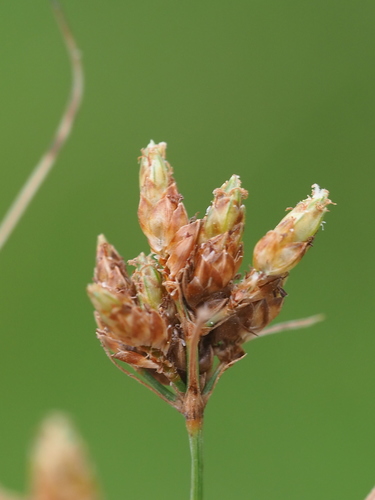
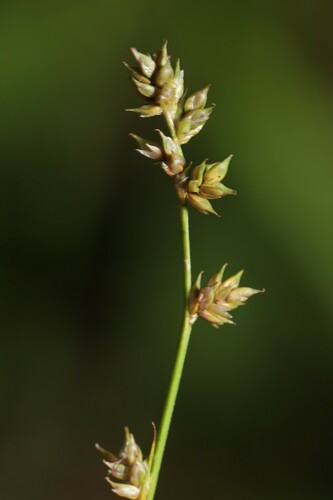
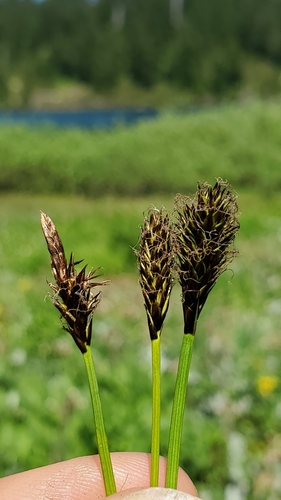
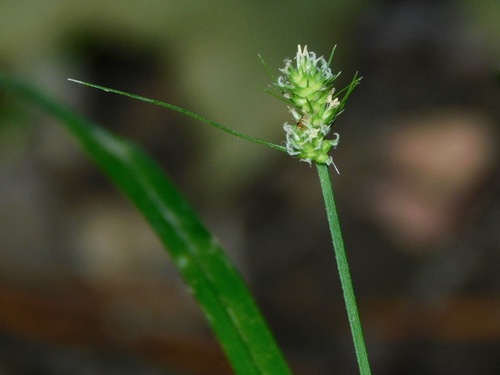
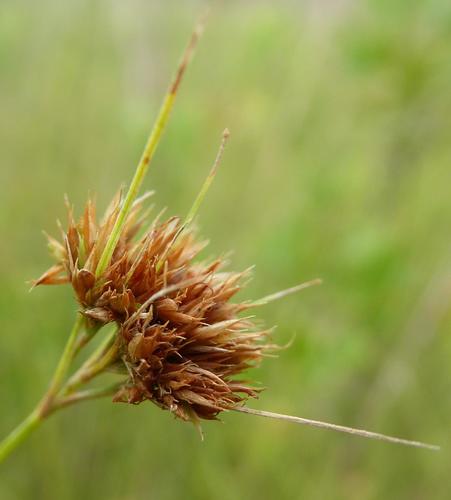
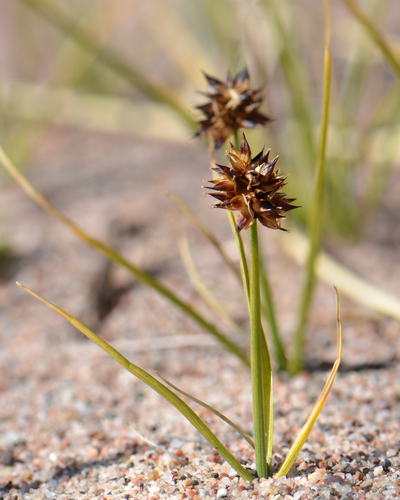
Curved sedge, formally named Carex maritima Gunnerus, is a perennial herbaceous plant. It grows from long, branched, fibrous rhizomes that produce either solitary shoots or loosely tufted clusters of shoots. Vegetative stems are extremely short, so they appear to be just a cluster of leaves emerging from the ground. Fertile stems are tough, nearly circular in cross-section, measure 5 to 18 cm long, and are often distinctly curved; 4 to 10 leaves grow from the lower half of each fertile stem. Leaves reach up to 15 cm long and 2 mm wide, are fairly stiff, often have inrolled margins and a slight twist, and taper to a fine, triangular cross-sectioned tip. The ligule, found at the junction of the leaf sheath and leaf blade, is short (1 mm) and rounded. The entire plant is completely glabrous (hairless), and its above-ground parts are dull green in colour. Flowering takes place in early summer; in Scotland, this occurs in April or May. The inflorescence is a single rounded head around 1.5 cm across, holding 4 to 8 spikes that each contain several flowers. The upper spikes are inconspicuous and hold only male flowers, while the lower spikes are female, occasionally with a single male flower at the tip. Bracts at the base of each spike are inconspicuous, with a similar appearance to the glumes. Female flowers are made up of a brown glume around 4 mm long with a pale midrib, narrow papery margins, and a pointed tip, plus a utricle (the structure holding the nut) of roughly the same size, with a split two-lobed tip and two stigmas. Utricles swell as they mature, darken to nearly black, and contain a biconvex brown seed. Male flowers have a 4 mm long brown glume and three anthers attached to long filaments. Curved sedge is protandrous, meaning male flowers open before female flowers, a mechanism that prevents self-pollination, and its pollen is dispersed by wind. Curved sedge has a circumpolar distribution across the northern hemisphere, found throughout northern Alaska, Canada, Scandinavia, and Russia. Southern outlying populations exist in the Alps, and possibly in the Himalayas, though the Himalayan record is based on only one specimen. The Global Biodiversity Information Facility holds one Himalayan record: a specimen collected in 1972 by Hiroo Kanai and Samar Bahadur Balla at "Lama Chungbu", which corresponds to Olangchung Gola, Nepal, at 4,300 m altitude. In North America, it is common in Alaska and Canada, and may not range as far south as the contiguous United States (the Lower 48). It was listed as provisionally present in New England in 1902, but there are few recent records from the region. The New York Botanical Garden holds specimens labelled "Carex maritima" from as far south as Texas, but these have been confirmed as misidentified. Some sources report curved sedge occurs in South America, specifically in Peru and Chile. One theory suggests it reached South America via a long-distance dispersal event around 250,000 years ago, during the late Pleistocene. Genetic studies show South American plants form a subset of the genetic variation found in northern hemisphere populations. However, more recent research proposes the South American plants may belong to a separate species, Carex melanocystis É. Desv., which appears to be more closely related to other sedge species. While curved sedge is not globally rare or threatened, it is considered at risk in locations along the southern edge of its range. In Switzerland it is classified as vulnerable (VU), in Britain it is classified as endangered (EN), and it has been incorrectly classified as extinct in England. It was speculated that climate change and human factors such as golf course development on dune systems could bring it close to extinction in England, but the species still persists at Lindisfarne in Northumbria. Curved sedge grows in two distinct types of habitat: at sea level and on high mountains. It is always found in areas where moving water acts on bare sand. At coastal locations, it grows in damp sand, at stream mouths, in dune slacks, and on turf beside rock pools. In Scottish machair, which hosts most of the British populations of curved sedge, this corresponds to EUNIS habitat B1.4 northern fixed grey dunes, which matches various sand dune grassland communities in the British National Vegetation Classification. On the Varanger Peninsula in northern Norway, it has been recorded in grassy upper saltmarsh dominated by Calamagrostis stricta, Festuca rubra, and Poa pratensis, with a ground carpet of Sanionia uncinata. This habitat corresponds to EUNIS habitat MA223T, Fenno-Scandian Calamagrostis stricta-sedge swards. In montane regions like the Alps, curved sedge grows on thin, sandy, sometimes clay or peaty soils around springs or alongside watercourses, alongside species such as Carex microglochin, C. bicolor, and Juncus arcticus in EUNIS habitat 7240 Alpine pioneer formations of Caricion bicoloris-atrofuscae. A key trait of curved sedge is that its populations often undergo large fluctuations: it can grow in great abundance in locations such as St Andrews Links in 1984 or Sumburgh Airport in the 1950s, then decline sharply a few years later. These temporary populations are sometimes thought to come from sand moved from sites with a buried seed bank. Its Ellenberg-type indicator values are L=9, F=8, R=7, N=2, S=1, and T=1, which reflect its preference for full bright sunlight, damp conditions, slightly alkaline pH, low soil fertility, low levels of salinity, and cold temperatures. Few phytophagous (plant-eating) insects have been recorded feeding on curved sedge. A specimen collected in Caithness in 1888 contained galls likely caused by larvae of the gall midge Planetella sp., but no other insect associations have been recorded in Britain. Curved sedge can be infested by several fungal pathogens. The smut fungus Anthracoidea karii (Liro) Nannfeldt, 1977 colonizes maturing utricles. Orphanomyces arcticus (Rostrup) Saville, 1974 forms black stripes on young leaves. Urocystis littoralis (Lagerheim) Zundel, 1853 causes lead-coloured stripes on the leaves.