About Carex lupuliformis Sartwell ex Dewey
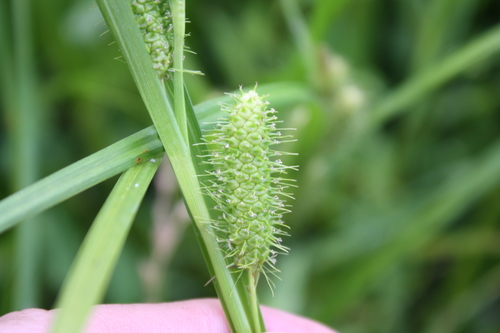
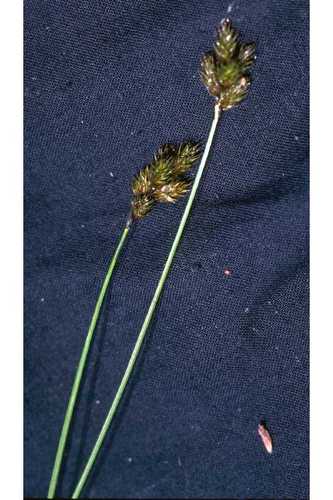
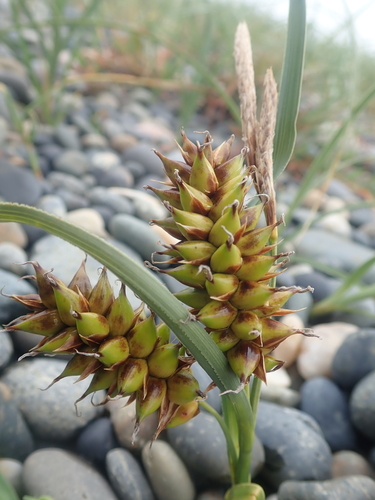
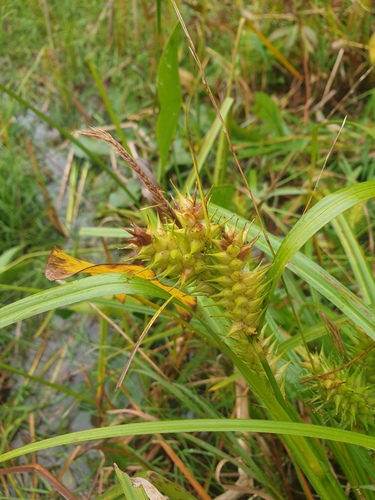
Carex lupuliformis Sartwell ex Dewey, commonly known as false hop sedge, is a perennial sedge with a sporadic distribution. It grows in floodplain forests and ephemeral woodland ponds in central and eastern North America. This species usually produces four to seven leaves. The sheaths of its distal leaves measure 3 to 21 cm long, and its ligules range in shape from rounded to triangular. Carex lupuliformis blooms between early June and early October. It typically bears two to six proximal female spikes; distal spikes are usually crowded, ascending, densely flowered, generally cylindric, and much longer than broad. It also produces one to two terminal male spikes. Fruiting occurs from late July through early October. Its fruit is described as having perigynia that are ascending to spreading, inflated, strongly veined, sessile, lance-ovoid, shiny, and glabrous, with a conical beak. The achenes are stipitate, broadly diamond-shaped, scarcely longer than wide at most, with concave faces, thickened angles, and are prominently knobbed with hard, nipplelike points.