About Carex longii Mack.
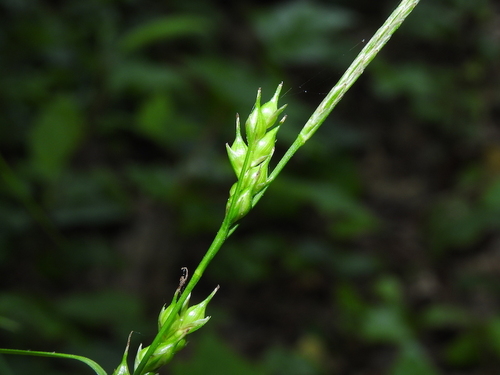
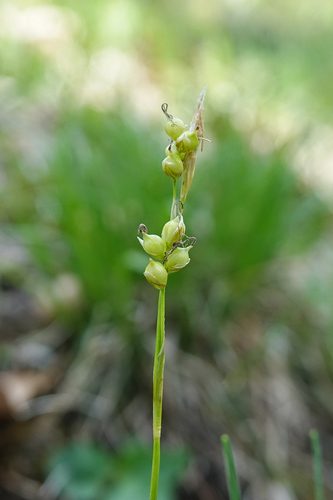
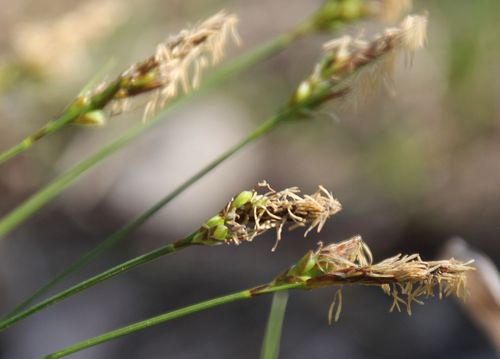
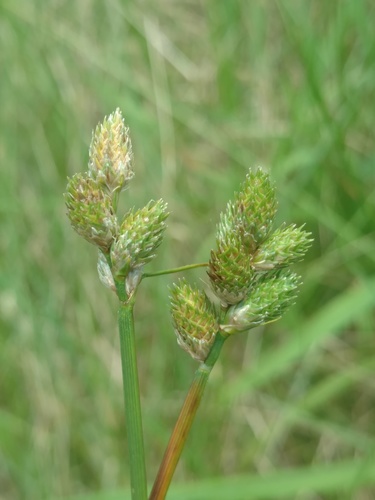
Carex longii Mack. is a sedge that grows in tufts made up of flowering inflorescences and leaf blades, reaching a maximum height of 40 cm. Its leaves are shorter than the inflorescences, 2 mm wide, and have light brown sheaths. The inflorescences consist of greenish-brown, sessile (stalkless) spikes that grow on stout, triangular stems. Each spike contains both male and female flowers; male flowers are located at the base of the spike, and female flowers have two stigmas. The glumes are shorter and narrower than the utricles, with an obtuse or subacute tip; they are hyaline, with a green midrib. The mature nut (fruit) is oblong in shape and yellowish-brown in color. The native range of C. longii extends across the eastern United States and north into eastern Canada. It is also native to the west coast of the United States, Haiti, Puerto Rico, Central America, and South America. It has been introduced to British Columbia in Canada, Oregon, Washington, Hawaii in the United States, and New Zealand. C. longii grows on the margins of wetlands in saturated or seasonally saturated soils. It occurs in low fields, bogs, and bottomlands. In Michigan, it is specifically found in low, peaty woods, along grassy borders of swamps, and on the wet shores of lakes. In North America, C. longii produces fruit between early and mid summer.