About Carex lasiocarpa Ehrh.
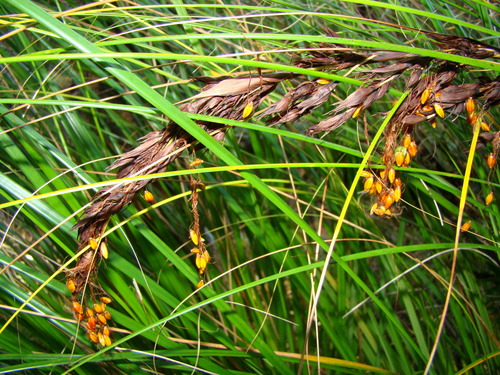
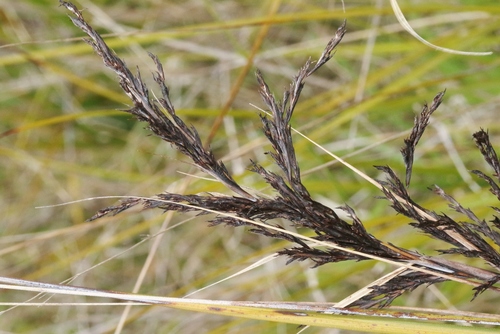
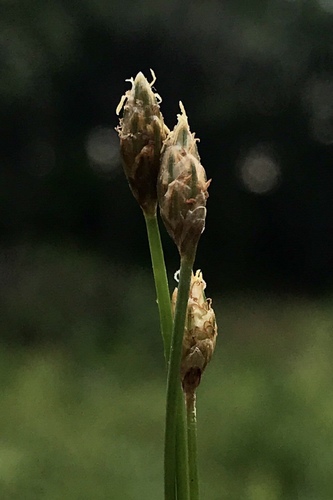
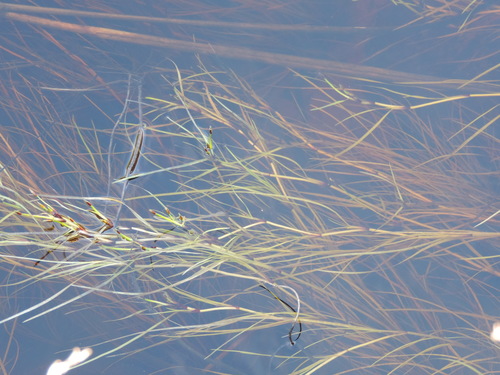
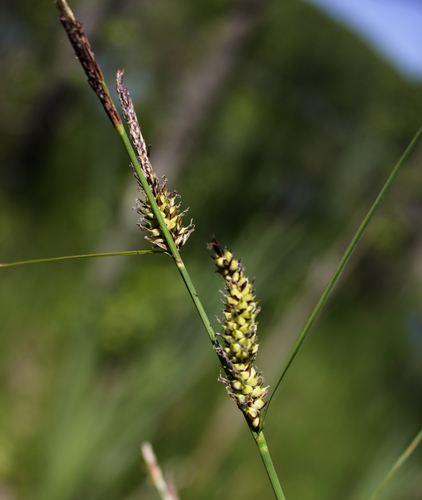
Carex lasiocarpa Ehrh. is a perennial sedge that spreads vegetatively to form dense stands. It produces erect stems that can exceed 1 meter (3 feet 3 inches) in height, paired with long, thin leaves. The stem holds one to several compact pistillate spikes, with one long staminate spike at its very tip. The pistillate spike vaguely resembles a tiny purplish or brownish ear of corn, and it contains many perigynia. This species has a broad distribution across much of North America and Eurasia. It grows in a range of freshwater wetland habitats, including bogs, fens, and shorelines. It also occurs in wet areas of moderately elevated mountainous regions. In the state of New York, it is classified as an indicator species for fens. It can form nearly single-species monospecific stands on shorelines and lakesides. Where water conditions allow, such as in wave-protected bays, this species sometimes forms thick floating mats. These floating mats frequently support a diverse community of other plants adapted to wet, low-nutrient conditions, including sphagnum moss, ericaceous shrubs, orchids, and carnivorous plants. Across its native range, Carex lasiocarpa plays an important role in developing distinctive plant communities along the edges of lakes and rivers.