About Carex hirta L.
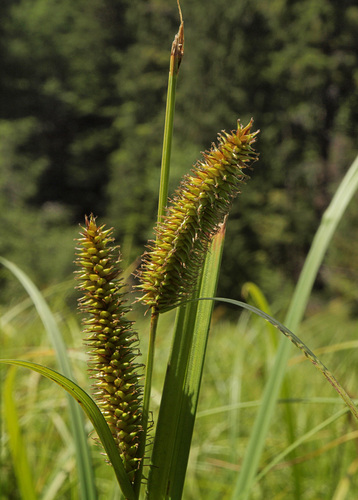
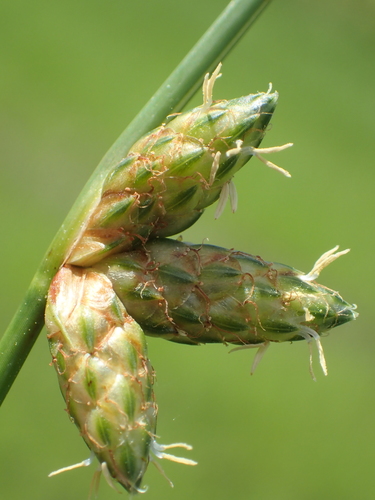
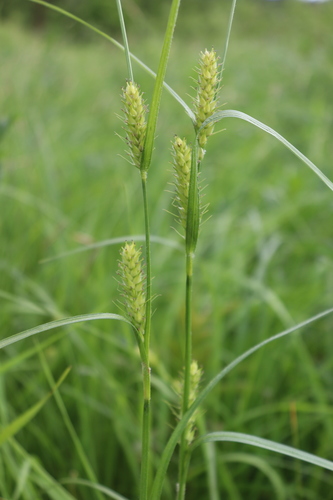
Carex hirta L. grows 15–70 centimetres (6–28 in) tall, with leaves 10–50 cm (4–20 in) long and 2–5 mm (0.08–0.20 in) wide, occasionally reaching up to 8 mm or 0.3 in wide. Its stems are trigonous, meaning roughly triangular in cross-section, but have convex, rounded faces. The leaves, leaf sheaths and ligules are all hairy; plants growing in wetter locations may be less hairy. This less hairy variant has sometimes been classified as C. hirta var. sublaevis by Jens Wilken Hornemann, but this classification may not be a taxonomically useful separation. Culms of C. hirta bear 2–3 lateral female spikes, each 10–45 mm (0.4–1.8 in) long, carried on half-ensheathed peduncles that can be up to twice the length of the spike. There are 2–3 male spikes at the end of the culm, each 10–30 mm (0.4–1.2 in) long. The hairy utricles, male glumes and leaves mean Carex hirta is rarely confused with any other Carex species. C. hirta is native to Europe, and is found throughout the British Isles, though recorded sightings become very scarce in the far north of the region. It has been introduced to North America. It was first recorded in Amherst, Massachusetts in 1877, and has since been found across most of eastern United States and Canada.