About Carex duriuscula C.A.Mey.
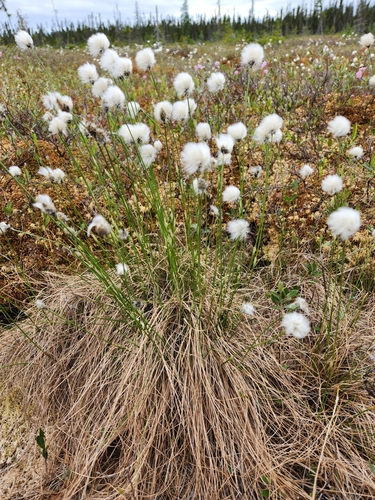
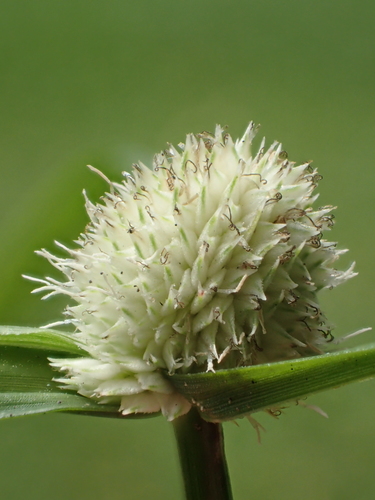
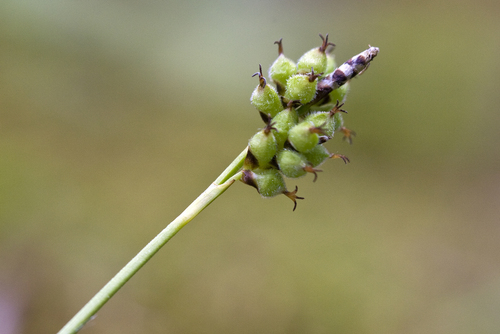
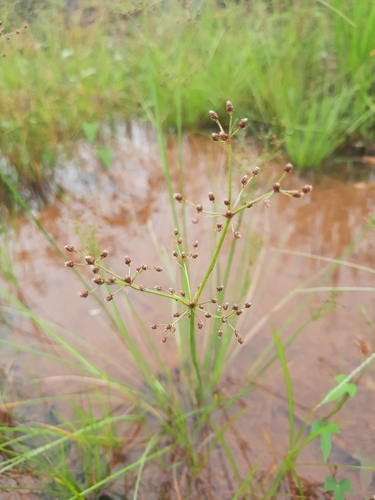
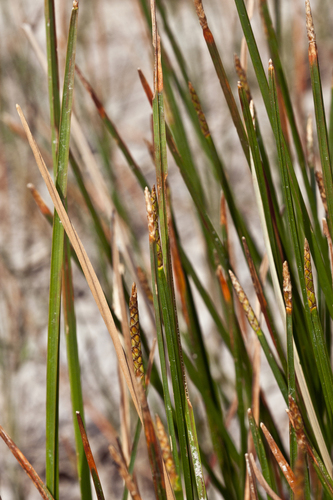
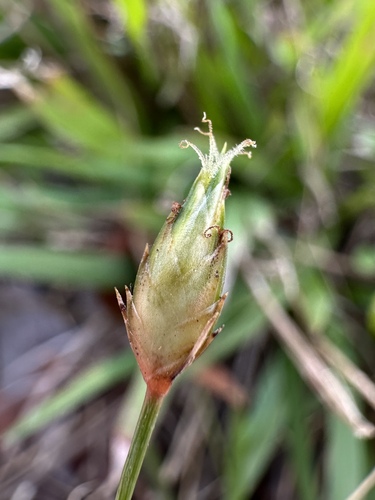
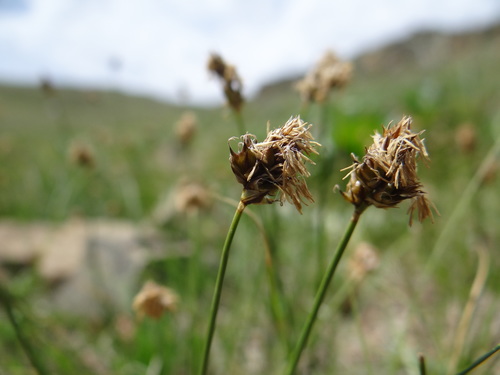
Needleleaf sedge (Carex duriuscula C.A.Mey.) is a herbaceous plant that forms tufts. It spreads via long, brown rhizomes that are 0.6–1.8 millimeters thick, and produces a large number of small fibrous roots. Its culms—flowering stems in grass-like plants—are three-sided at the base, with blunt corners, and are quite smooth toward the top. Culms typically grow 10 to 35 centimeters (4 to 14 inches) tall, and occasionally as short as 6 centimeters (2.4 inches). Culms emerge from the rhizomes either singly or in small groups. The leaves are very narrow, 0.5–1.5 millimeters wide, with edges that can be either rolled inward or flat. Leaves are always shorter than culms, and have a slightly rough surface. Leaf bases are covered in brown to dark-brown sheaths that disintegrate into fibers. The inflorescence at the top of a culm measures 0.7–2 centimeters tall; for pistillate (seed-producing) inflorescences, the width is roughly half the height. Pistillate glumes—scale-like bracts positioned under the spikelet—are broadly ovate or elliptic, rusty-brown in color, with a glassy, hyaline white edge and tip. Needleleaf sedge has an extensive range, stretching from eastern European Russia through Siberia and Alaska to the Upper Midwest of the United States. It also has a disjunct population in Irian Jaya, the western part of the island of Papua New Guinea. In China, it is widespread across the north and east, and absent from the southwest and west. It also occurs in Mongolia, Korea, and Kazakhstan. In arctic and subarctic North America, the species grows in Alaska, Yukon, and the Northwest Territories. It is native to all four western Canadian provinces: British Columbia, Alberta, Manitoba, and Saskatchewan. In the contiguous United States, it is most common in Rocky Mountain states and the northern Great Plains states, including Montana, North Dakota, South Dakota, western Minnesota, Wyoming, Nebraska, Colorado, and northern New Mexico. Further east, it occurs in widely scattered areas of Iowa, Illinois, Missouri, and Kansas. It is native to every western U.S. state, but only found in a few counties per state: for example, in California it grows only in the Great Basin province, in the White and Inyo Mountains. Its typical habitats include dry prairies, sagebrush grasslands, and openings in dry forests. In North America, it grows at elevations of 300–3,300 meters (980–10,830 ft), while in China it usually grows between 200–700 meters (660–2,300 ft), and is rarely found as low as 100 meters (330 ft). A study of pastures in the Barguzin Valley, Buryatia, Russia found that intensive livestock grazing has caused steppe pastures to become dominated by needleleaf sedge and fringed sagebrush (Artemisia frigida).