About Carex davisii Schwein. & Torr.
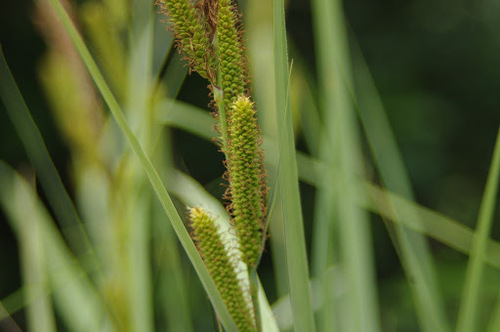
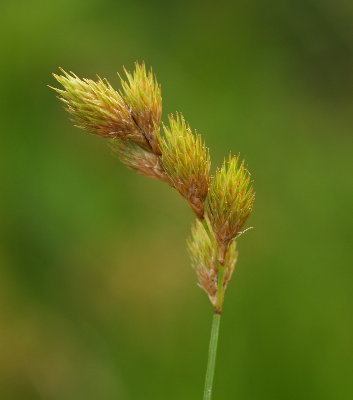
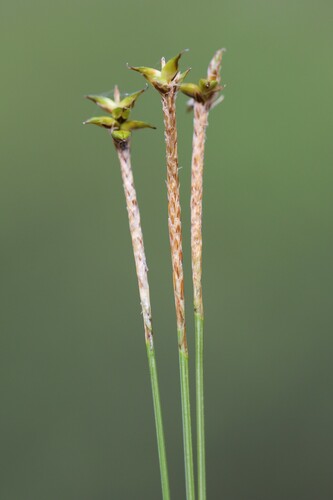
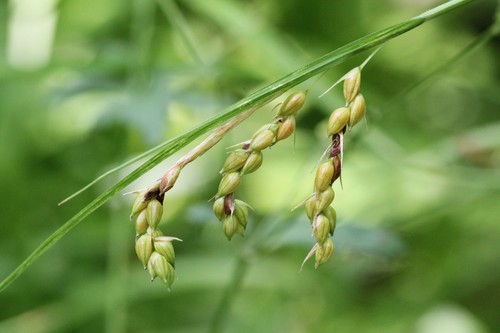
Carex davisii Schwein. & Torr. grows up to 0.91 meters (3 feet) tall, forming loose clumps. Its leaves reach up to 30 centimeters (1 foot) long and around 8 millimeters (0.3 inches) across. The underside of its leaves is usually slightly hairy, but may be hairless (glabrous), particularly in populations growing further west. When young, the base of the culms and basal leaf sheaths are dark red, turning brown as they mature. Each flowering stem holds 2 to 5 spikelets that droop when fully grown, attached to peduncles up to 25 millimeters (1 inch) long. The terminal spikelet is androgynous, meaning it is staminate (male) at the base and pistillate (female) at the tip. Each mature lateral spikelet contains 12 to 30 plump perigynia. The perigynia measure 4 to 5.5 millimeters (0.16 to 0.22 inches) long and 2 millimeters (0.08 inches) across, are ovoid with a short beak, and turn orange-brown as they mature. Each perigynia is subtended by an awned scale up to 0.5 millimeters (0.02 inches) long; the body of the scale is shorter than the mature perigynia, but the awn is often longer than the perigynia. Carex davisii can be told apart from other similar sedges in section Carex sect. Hymenochlaenae, such as Carex formosa, by its longer awned perigynia scales and lateral flowering spikes that hold one or two male flowers at the base. In terms of distribution and habitat, this species occurs in eastern North America. Its range extends from Vermont west to Ontario and North Dakota, south to Tennessee and Texas, and does not include the southeast Atlantic coast. It most commonly grows in rich floodplain forests, river bottoms, and mesic woodlands associated with large streams. It can also be found in calcareous oak savannas and meadows.