About Carex conjuncta Boott
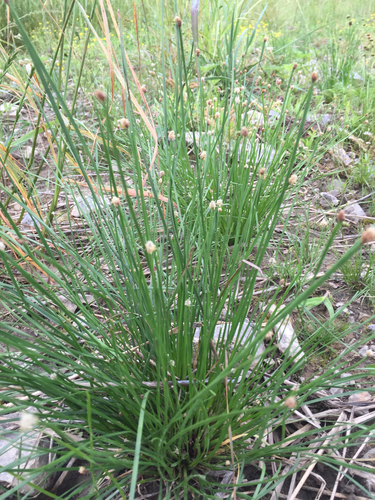
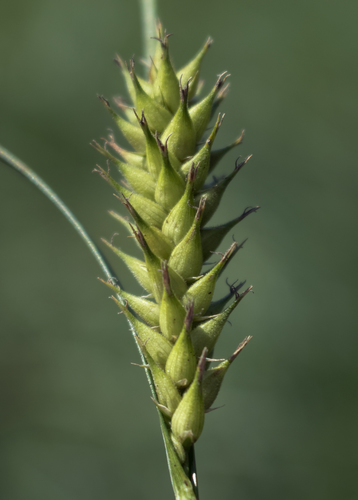
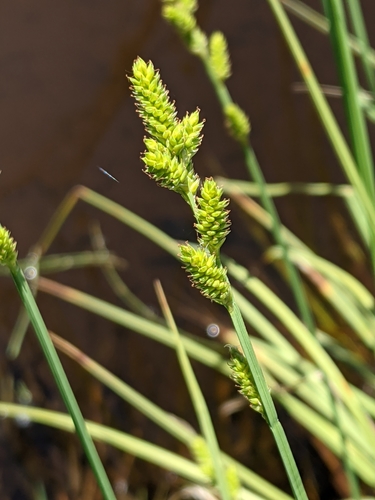
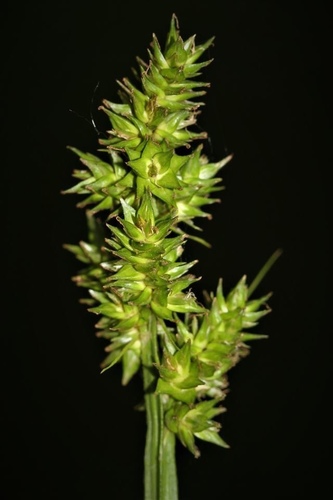
Carex conjuncta Boott is a clump-forming herbaceous perennial plant. Dried stems from the previous growing season persist around the base of the plant. This species grows to a height of 40–80 cm (16–31 in), with stems that are stout yet soft, and typically measure 2 to 4 mm wide, though they can reach up to 10 mm wide. Its perigynia are elongated, 3 to 5 mm long and roughly half as wide, widest near the base and tapering to a toothed beak. Its achenes measure 2.2 mm long and 1.4 mm wide. The natural distribution of Carex conjuncta is within the United States, ranging from New York west to Minnesota and South Dakota, and extending south to Virginia and Kansas. It is an uncommon species across most of its natural range, but it is more common in the central portion of its range in Missouri and Illinois. It grows in damp woods, hardwood swamps, wet meadows, and marsh edges. In Minnesota, it is only known from a small number of locations in alluvial forest in the Cannon River Valley, where it was first documented in 1976. In this region, it grows in moist forests dominated by Ulmus americana, Juglans nigra, and Acer saccharinum. These forests commonly flood in the spring, and their soils remain saturated throughout the entire growing season. In Minnesota, other uncommon species that grow in association with Carex conjuncta include Carex davisii and Carex grayi.